Mirrors & Shadows

“Ten times a day you must overcome yourself.  You must want to burn yourself up in your own flame.”

-Friedrich Nietzsche-

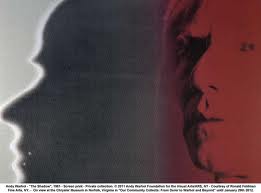
The Shadow, Andy Warhol

“the lesson is clear: one is multiple, the same is different, the representation is the negative of the person…both original and copy, identical and different, they are the same and the other, interchangeable and monumental…In the dark room of his studio, Warhol develops himself.  In so doing he ‘unmakes’ himself.”

-Victor Stoichita-

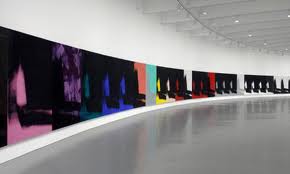
Shadows, Andy Warhol

“Death follows artists around like their shadow and I think that’s one of the reasons artists are so conscious of the vulnerability and nothingness of life.”

-Francis Bacon-

Children singing choruses.  Joyous chants and rhymes.  Distant.  Repetition forming memory.

Chasing shadows, or running from.  Self-same body blocking sun.  To be sought, to be feared.  Identical and strange.

Known alone in traces and reflections.

I say that “I” was young once.  That it’s only patterns of light, only the passing of time, only angles of vision.

I repeat myself.

Each day reassembling, developing, dissembling, to reassemble again.  My body a gathering post.

Mirroring image has gone from the closest thing to self-awareness we might uncover to a flat reflective surface full of nothing.  Ephemeral and changing by the second, dependent on the looker, a vacant mirage.

Shadow has proceeded from a designator of real presences to an outline of actual vacuity.  From a measurable symbol of substance to a vague hint of objects passing.

Voices like a bag of small bells and grass.  Something shaking and stirred.  Snippets of a tune, the catchy parts.

What I can tell I read, observe, attend and consider, opening a dialogue of days.  But I only get to see in glimpses and portions.  A hand moving, holding an instrument here; flat feet from crossed legs there; a shoulder, some hair of a beard, the frames of glasses.  I don’t see myself seeing, nor see myself as seen.

There’s the mirror and the shadow – intangible, eminently interpretable and malleable “things” – emphases of the transitory.  Receptacles like language – merely signs or indices – pointing back at absence.

Moment, moment, moment…now then now then now…endless fantasies of dissection moving round the room, faster than shuttling clips of film.  A self presenting / representing itself after again, appearances only, shimmering skein mingling veils of light…

While they sing like breezes dreaming – “Who sees?” and “What is seen?”

He who has ears let him hear,

bypassing illusion,

in marks and gestures

Question

Aspects of Writing: Writing the Impetus. The Self-Reflexive.

The Self-Reflexive.  Impetus.

The urgency, that is, the urging I feel in setting forth to compose, is dismantling.

In other words, the forcings that encroach, impinge and unleash within me when I’m ‘of a mind’ (experiencing the intention of) ‘to create’ is one of destruction, a defensive attack.

I am thus synonymed by sculptor, woodcarver, archaeologist.

One wants to undo the stories before they reach the page.

In order to find, discover, the figure of them, a more lasting (perhaps) form or shape.

To strip them of their ‘qualities’ or ‘style.’  Their manipulations.  Creation as a straining of the weak, the falsifiable…a process in survival of the fittest, the more “true”(?) or apt.

Chiseling personal explanations and perspectival descriptions down to possibilities.  Unraveling myths toward oracles.  Discounting proofs into theories.

The impetus of writing evokes the motivation of doubt, the landscape is struggle.

“To be inspired” might mean to be activated by an experience accurately called “perfink” (David Krech), or, “perceiving, feeling and thinking at once” (Jerome Bruner).

Regurgitant feeling: investigation, analysis, interpretation – meanings attacking meanings, in hopes.  In hopes that a perfink of “meaning” (a satiation of anxiety, terror, doubt) might prove indestructible – as a possibility.

The narrative, then (the verbal expression of a perfink), is a traffic jam of conventions, presuppositions, reality-views and solipsistic Gnosticism forged within the forging self; writing – as apparatus, activity, function – reflexes: brings self-world to bear on self-worlds in attempts to deconstruct automatic (as it were) constructions of perceiving/feeling/thinking – fighting, clawing, tearing against it with the information and energy of shared resources: language, “knowledge,” the usable past.

Clashings of systems, perfinking perfinks, violent internal skirmishes and acts of terror(ism) – a doing that attempts the undoings of doings – an otherwise endlessly insular, of unverifiable and infinite traces, activity known as self-reflexive

– producing stalemates of exhaustion, individual paucities of supply and reinforcement, ourobourosian

offering only extrinsic chances for momentary cease-fires – the artifact, figure, form of the battlefield, photographed in process and thus submitted – to critics, to readers, to colleagues, to shadows (i.e. to genuine Others) that it might become real (exist in relation, to be directly experienced), corroborated or dismissed by equally limited and idiosyncratic perfinking, outside – both in the world, and of it.

“the contest any artist has with his or her art: working toward a perception that is his or her mind’s peace.”

-Louis Zukofsky-

“the mind carries an austere

inwardness that will not put out its eyes”

-Laurie Sheck-

“Writing is a lonely business’ is both a dull myth and a material fact of the profession, one I happen to be temperamentally suited to endure but which doesn’t gratify my sense of what it’s for.”

-Jonathan Lethem-

Creeley

-Robert Creeley-

see Aspects of Writing

Emissions from the Helmet of Horror, novel mythology-cognitive-science-literature-art

“no one realised that the book and the labyrinth were one and the same…”

-Borges, The Garden of Forking Paths-

[as leaked from the skull stuck to Victor Pelevin]

“…progress is a propulsion technique where we have to constantly push ourselves away from the point we occupied a moment ago…the funny thing is that the concept of progress has been around for so long that now it has all the qualities of a myth.  It is a traditional story that pretends to explain all natural and social phenomena.  It is also a belief that is widespread and false.”
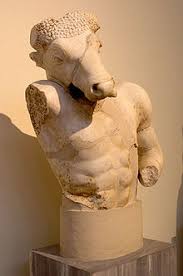
“If a mind is like a computer, perhaps myths are its shell programs: sets of rules that we follow in our world processing, mental matrices we project onto complex events to endow them with meaning.  People who work in computer programming say that to write code you have to be young.  It seems that the same rule applies to the cultural code.  Our programs were written when the human race was young – at a stage so remote and obscure that we don’t understand the programming language any more.  Or, even worse, we understand it in so many different ways and on so many levels that the question ‘what does it mean?’ simply loses sense.”

Ariadne:  “…The diagram was called ‘the helmet of horror’ — it was written in big letters above the drawing.  The main body of the machine was shaped like a helmet.  And there was an identical helmet standing on the demonstration table — an ancient bronze headpiece, and underneath it a visor with holes in it curving back inside…Its lower section ran back inside the helmet through a slit in the middle of the face.  And there were some kind of side plates too — everything was very old, green with age.  It looked like a Roman gladiator’s helmet — like a bronze hat with a visor.  Only this one had horns as well.  They came out of the upper section of the helmet and curved backwards…the helmet of horror consisted of several major parts and a lot of secondary ones.  The parts had strange names: the frontal net, the now grid, the separator labyrinth, the horns of plenty, Tarkovsky’s mirror and so forth.  The largest element consisted of the now grid and the frontal net.  It had two parts that were sometimes fused into a single unit.  Its external part, the net, looked like a visor with holes in it, and its internal part, the grid, divided the helmet into an upper section and a lower one, so there was no way you could squeeze even the smallest head into it…the now grid separates the past from the present, because it is the only place where what we call ‘now’ exists.  The past is located in the upper section of the helmet, and the future in the lower section…The helmet’s operating cycle had no beginning, so it can be explained starting from any phase.

“…start by imagining the gentle glow of a summer day caressing your face.  That’s precisely how the frontal net, heated by the action of the stream of impressions falling on it, transmits heat to the now grid.  The grid sublimates the past contained in the upper section of the helmet, transforming it into vapour, which is driven up into the horns of plenty by the force of circumstances.  The horns of plenty emerge from the forehead, curve around the sides of the helmet and intertwine to form the occipital braid, which descends into the base of the helmet.  There, below the now grid, the bubbles of hope that arise in the occipital braid are ejected into the region of the future.  As they rise, these bubbles burst against the now grid, generating the force of circumstances, which induces the stream of impressions in the separator labyrinth.  And the stream of impressions, in turn, is shattered against the frontal net, heating the now grid and renewing the energy of the cycle.

“It’s not always hope at all, it’s more likely to be fear and apprehension, suspicion and hate, all sorts of nonsense, in fact any of the cud that is chewed with such habitual stupidity…technically speaking it is correct to call them bubbles of the past.  They are called bubbles because their constant tendency is to expand and occupy the entire volume of the helmet, preventing anything else from appearing in it and leaving no space or opportunity for the recognition of what is actually happening…since past is enriched exclusively with more past, the bubbles of hope consist entirely of past, they are simply past in a different state…

“The separator labyrinth is the most important part of the helmet of horror.  It’s the place where everything else is produced out of nothing, that is, the place where the stream of impressions arises.  And it’s also the place where the past, present and the future are separated.  The past moves upwards, the future moves downwards, and the present, in the form of the stream of impressions, falls on to the outer surface of the frontal net, generating the cycle’s passionate desire to recur, so that it becomes a kind of perpetuum mobile…”

“That means that it’s past that decomposes into past, present and future?  In actual fact the whole cycle is simply the circulation of now in various states of mind, in the same way that water can be ice, or the sea, or thirst.”

“…the ‘inside’ and ‘outside’ have no existence in themselves.  They are generated by the separator labyrinth by the force of circumstances and from there they enter the horns of plenty, where they enrich the past, transforming it into the state of bubbles of hope.  But since there is no ‘inside’ or ‘outside’ anywhere except in the horns of plenty, the stream of impressions can quite easily arise inside the helmet and fall on to it from the outside.  And the same applies to everything else as well…never under any circumstances regard anything as real.  The entire phenomenon is induced, like the electromagnetic field in a transformer…as far as I could understand it, the horns of plenty operate like enrichment units in a chemical plant.  When it’s driven through them by the force of circumstances, past gets mixed up with everything else, becoming richer and acquiring value, with the result that bubbles of hope are produced in the occipital braid, go gurgling through the region of the future, are reflected in Tarkovsky’s mirror and perceived as the novel freshness of a brand new day.”
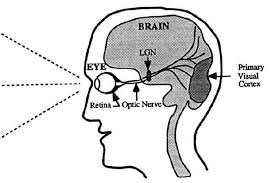
“In real life what you see depends on where you look…the word ‘change’ has no meaning…where you’re looking depends on what you see.  Is that clear?”

“The future is produced from the past, so the further we go into the future, the more past is required to produce it.”

“Free will.  Life’s like falling off a roof.  Can you stop on the way?  No.  Can you turn back?  No.  Can you fly off sideways?  Only in an advertisement for underpants specially made for jumping off roofs.  All free will means is you can choose whether to fart in mid-flight or wait till you hit the ground.  And that’s what all the philosopher’s argue about.”

“Always the way when you feel you’re just about to understand something important.  It’s like the whistle of a bullet or the roar of an aeroplane.  If you can hear them, it means they’re already zooming past you.”
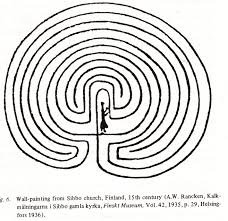
“…a labyrinth comes into being in the course of any discussion with yourself or others, and for that period of time each of us becomes either the Minotaur or his victim.  Although there is nothing we can do with this…there’s nothing we can do without it either…even the discourse itself can only come into being within the discourse.  But the paradox is that, although the entirety of nature arises within it, the discourse itself is not encountered anywhere in nature and was only developed quite recently…Basically a labyrinth comes into being when you have to choose between several alternatives, and the alternatives are a set of our possible preferences, conditioned by the nature of language, the structure of the moment and the specific features of the sponsor.”

“Perhaps that’s the whole point.  Not to think about where the way out is, but to realise that life is the crossroads where you’re standing at this precise moment.  Then the labyrinth will disappear as well.  After all it only exists as a complete whole in our  minds, and in reality there is nothing but a simple choice — which way to go next…We’ve all got dead-ends.  Only it’s not obvious straightaway, it just takes a little while.”

“The helmet of horror fractionates the one thing that is, into the multitude of things that are not.  But since the helmet of horror is in no way the one thing that is, it is also one of the multitude of things that are not.  And the things that are not may enter into every possible conceivable and inconceivable kind of relationship, since these relationships do not in any case exist anywhere except in the helmet of horror, which does not actually exist itself…An individual by the name of A may be a part of the helmet of horror worn by B, and an individual by the name of B may at the same time be a part of the helmet of horror worn by A.  This is the final infinity in both directions, and often both of them are quite nice people.”

“The means by which for many millennia he has attempted to make himself real are terrible and foolish, like all the mysteries of his world.”

A remarkable new mythology from Victor Pelevin

(all above quotations arise from!)

Our Mysterious Callings, er, befuddling vocations

continuing qualia…


{eliminating parts of speech and tense(-ing)s}

            Where we began, and when, was next-to-nothing.  How must have been something, and the what bears repeating.  Complex and variegated channels, ganglia alike to beans taking root, nutty and filigreed.

The event is conception and all its pertinent involve (where-when-events) – resultant growth of hairy little what-hows.

What is a theme-and-variations composition, melodies often scarce to trace, but certainly music!  Thrumming drumming subtle, with irregulating tremors, shushing swinging bellowed strings, replete with punctuations.  A human is a riffing thing, something of artist’s collage coupling biological systems and common laws relatively, referred to as patterns.

Person is an unstaid element, living requiring stimulation and acknowledgements, enough continuity to be.  Elaborate contexts of nurturing structures and their vice-versas.  Cells swimming fluids, objects in umwelts, mini-beasts scuttling a globe, as seen from various distances (perspectives not visibly limited).

Existences like screens full of mimeographed transparencies layered and colored by hands.  Bewildering tangles of syrup and string.  Odd combos when mirrored by mirrors, as mirroring means.  Two-sided at least.  Reflected subjectivities / subjective reflections, sort of spinning things set on a gyro turning tilting.

Nurturing structures of what-hows commons: language, culture, environment and arts.  Structuring nurture of sustaining nourishment, awareness (attention) and semblance of security.

And there you have a person (a what-how) and a world (where-when-event); synonymously person-making-world, er, world-making-person toggling looping recursive spirals adjusting discontinuous connectivities…

Perhaps each and overall what-how’s where-when-events all beggar why (i.e. remain puzzling) at which point (or somesuch of the like) there probably arises a who.  Who and why as yet unknown, being conjectured derivatives only from how-what in where-when-events.

All demanding further potentially endless inquiry and study and inventive erasures of conventional grammars and parts of speech.

To be continued…

A strong mid-section

OCTOBER 2011

POSTMODERNISM AS LIBERTY VALANCE: NOTES ON AN EXECUTION

THE RITUAL KILLING OF POSTMODERN LITERATURE IS A THREE-MAN GUNFIGHT AT THE O.K. CORRAL (ALLEGORICALLY SPEAKING)

Finding a lot of resonances and curiosities in this collection that I’d like to recommend – a fruitful pattering of words to engage – I especially have liked the introduction (can’t find pdf of online) and then I thought the midsection of the essay linked above (click anywhere on the opening titles to read) was strong and productive.

Questionable

Spinning in a bit of ineffectual conundrum…what reaches the paper expands…

Does remarking constitute remarkable?

Do I discover value only when change causes difference?

Is recognition of closeness a result of disjunction?

What engineers a ‘train of thought’ – who lays the track?

Which is more creative – reading or writing?

When are thoughts and feelings the same?

Is language a metaphor?

Who asked you?

Does the talking stop at conversation’s end?

What does skin separate?

When does beginning begin?

Why is death?

What is meant by ‘same’?

Is there anything as dangerous as freedom?  Anything as certain as risk?

What  are the ingredients of making?

How do we identify?

Do emotions signify?  If so, what?  If not, why?

When?

What is gained by loss?

Are these questions rhetorical?  Essential?  Trivial?  For whom?

Who answers how and what kind of who does that make?

What?!?

Please feel free to respond to any or all of the above – wisdom/insight/hypotheses are warmly welcomed!

Thank you : I don’t know what I am saying…

received this little garland today and a congratulations from WordPress – my account is 1 year old!

“Express only that which cannot be expressed.  Leave it unexpressed.”

-Maurice Blanchot-

“The world eternally turns round; all things therein are incessantly moving, the earth, the rocks of Caucasus, and the pyramids of Egypt, both by the public motion and their own.  Even constancy itself is no other but a slower and more languishing motion.  I cannot fix my object; ‘tis always tottering and reeling by a natural giddiness; I take it as it is at the instant I consider it; I do not paint its being, I paint its passage.”

-Michel de Montaigne, 1580-

“Sincerity – it’s the insatiable process

of transition, of fluctuation…”

-Arkadii Dragomoshchenko-

I began one place, and become another.

Wallace remarked that the most difficult thing to teach young writers was the difference between expressive writing and communicative writing.

“Two utterances cling tightly to each other, like two bodies but having indistinct boundaries.” (Maurice Blanchot)

A notification informs me that today is the first anniversary of my experience of the blogosphere.

Humbled over 365 days.

And thank you.

.

I imagine many writers/artists start out, in the youth of their writing (or creative work) from a singular sense.  There’s this “me” experiencing this “world,” it seems like – an I and a chaos, an identity and a multitude.  When the I (or eye) feels full, it is like to burst.  Things touch us, hurt us, impinge on our locus, our “self,” and it seems something must be done about it – we must exert – strike back, reach out, kiss, craft – exhibit our presence.  Interact.  The dualities are clear.

Are confused.  Experience turns out to be very mixed, an impossibly confusing weave.  As we begin to plunder these “moments,” we’re countered.  Things that happened to us, we were there for, in all fairness, our activities encroach.

We begin perhaps to recognize our existence as agents – not only done to, but doing; not only recipients but respondants, reactive.  The wrestle of expressing ourselves through materials (language, movement, matter or sound) teaches us this.  The Other’s inextricably woven – what occurs and results is the same.  Is unlike.  We lose balance.

Conceiving the work as a subject toward object (our creating) deriving from object to subject (our experiences) – our investigations quickly expose this  unclear.  Attacked by requirements of how.  Stubborn like marble or tricky as oils, even recalcitrant conventions, we begin to comprehend a falsity to working on, as a single direction, and realize it’s all a working with.  And we struggle.

Even working with.  The earth, or people, or bodies, or clay, things rarely abide our intentions.  We set out to disburden ourselves, get incited to construct or create (to “use”) and find ourselves consistently foiled.  Reality doesn’t care.  We find precious little room for expression.  Compromise and nuance, novelty or style – ineffective to the longings we exude.

Perhaps at this stage we lose faith in our voices or visions – what we seek we does not seem to obtain.  This is fine.  This is something no product can resolve.  For there isn’t.  There is no solution to life.  We are IN it.  And there is no replacement for death.  Then we’re OUT.

Whether language or matter, movement or sound, our “I” never works on an Other.  We are INsulated.  INextricably.  Communicative activity means cohabiting the spaces, simultaneous-ing the times.  Realities – experiences – accord.  Everything possessing the prefix co-.  It’s admitting the reciprocal, the recursive – we’re not separate beings being, we are beings expressing ourselves commensurately.  Perhaps control is adjusting to convention.  Accepting agreements with place.  Expression living IN and WITH, communication the word for the weave.  That we’re behaving, creating, co-mposing in inseparable connectivity (inexpressible process) – transition, fluctuation, IN –

– attempting to paint its passage.

entanglement. emergence. complexity. matter.

Thanks so much for  reading, joining, my attempts.

N Filbert 2012

Of Inquiry (Inquiring)

Of Inquiry (Inquiring)

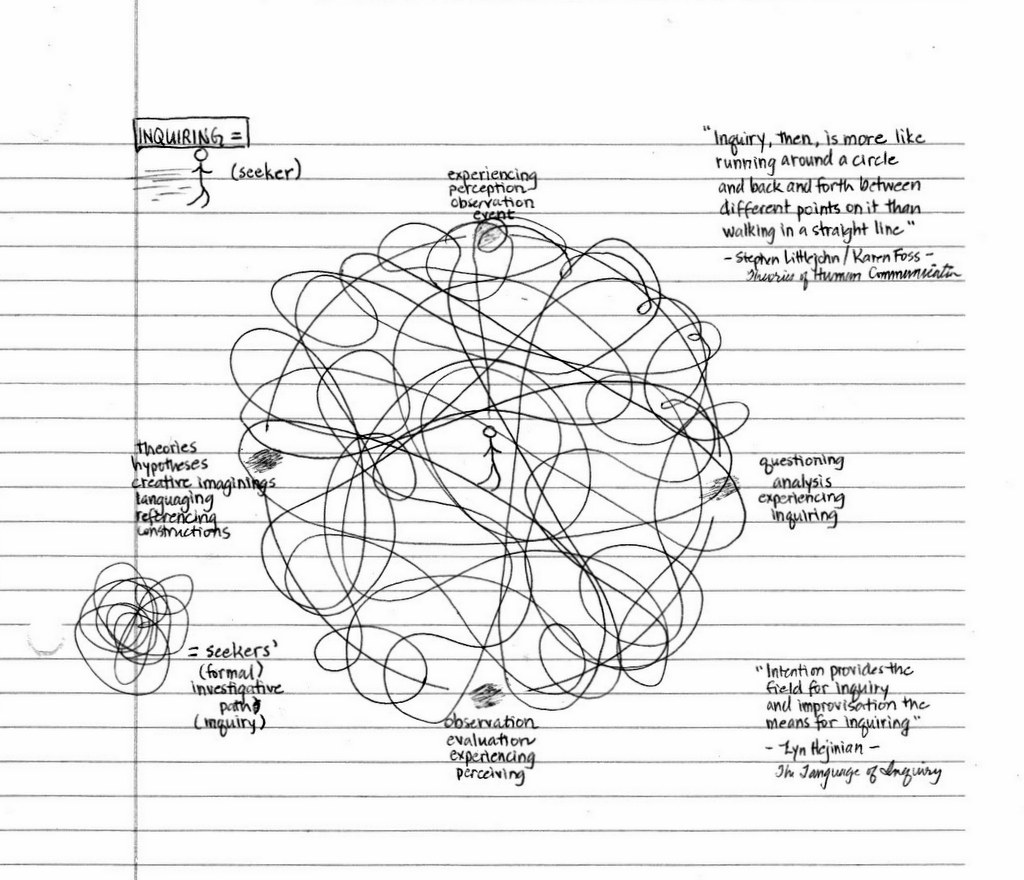
“Inquiry, then, is more like running around a circle and back and forth between different points on it than walking in a straight line”

-Stephen Littlejohn / Karen Foss-

Theories of Human Communication

            And yet whoever thought of it otherwise?

Still sometimes we use logic, as diversion, among the so-called “points,” letting it go.  Circular, perhaps, in that way.  Much as we’d like to, never quite constructing a web.  For capture.  Or a moment to observe, re-flect.  Rather, more de-flect.

If you get their picture.

Would be something like this:


“Intention provides the field for inquiry and improvisation the means for inquiring”

-Lyn Hejinian-

The Language of Inquiry

That is, I assume, if for “improvisation” we substitute some creatively imagining wandering – the wonderings of intention or querying of some inceptive experiencing?  After a fashion.

I’m prone to argue the “point.”  I.e., “What/where/when/how – a ‘point’?”  Inconceivable for me.  As my understanding of ‘point’ is like my comprehension of ‘god’ or ‘time,’ ‘truth’ or ‘being’ – concepts as moving targets without definite characteristics – indefinable insubstantials.  E.g., the falsity of my diagram.

It wouldn’t surprise me if I thought of inquiry as motricity.  When we intend to inquire we’re moving (point-less) and inquiry moves us (point-less) among (therefore, obviously) moving things (thereby point-less), if only in relation to us.  The denial of a dead present.  Pointedly.

No stasis for the living.  Life (logic leads), as, literally, pointless.


So how do we refer?  Index?  Sign?  “Point” to – in all this motion?  Commotion?

Language levies us these lies.  These helpful and distorting machinations and maps of partial, hazy truths.  Like mathematical “laws” providing invisible scaffolding in which to graphically refer.  To question and inquire into falsely stable invisible objects.  Creative and imaginative markers.  Hypothetical space-time convergences – true experientially – but unlocatable save for the traces in ongoing movement – unstoppable, uncharitable, unrecordable – each stoppage (representation), chart or reading of ‘reality’ being an-Other, a deflection, an improvisation and wandering (i.e. a new experiencing)…

…dropping the term “experience” as blatantly false.

…retaining till death “experiencING.”

Not, then, “to question,” but questionING, one and same with observING, evaluatING, inquirING, seekING, readING, creatING, fabricatING the impossibility of a truthful past tense.

…running round and round and back and forth,

not between points,

simply, actually, between.


N Filbert 2012


Masterful Hejinian on Language

“Language discovers what one might know, which in turn is always less than what language might say.  

We encounter some limitations of this relationship early, as children.  Anything with limits can be imagined (correctly or incorrectly) as an object, by analogy with other objects – balls and rivers.  Children objectify language when they render it their plaything, in jokes, puns, and riddles, or in glossolaliac chants and rhymes.  

They discover the words are not equal to the world, that a blur of displacement, a type of parallax, exists in the relation between things (events, ideas, objects) and the words for them – a displacement producing a gap.

Because we have language we find ourselves in a special and peculiar relationship to the objects, events, and situations which constitute what we imagine of the world.

Language generates its own characteristics in the human psychological and spiritual conditions.

Indeed, it nearly is our psychological condition.

This psychology is generated by the struggle between language and that which it claims to depict or express, by our overwhelming experience of the vastness and uncertainty of the world, and by what often seems to be the inadequacy of the imagination that longs to know it – 

Language is one of the principal forms our curiosity takes.

It makes us restless.

As Francis Ponge puts it, ‘Man is a curious body whose center of gravity is not in himself.’

Instead that center of gravity seems to be located in language, by virtue of which we negotiate our mentalities and the world; off-balance, heavy at the mouth, we are pulled forward.

Language itself is never in a state of rest.

Its syntax can be as complex as thought.  And the experience of using it, which includes the experience of understanding it, either as speech or as writing, is inevitably active – both intellectually and emotionally.

The ‘rage to know’ is one expression of the restlessness engendered by language.  ‘As long as man keeps hearing words / He’s sure that there’s a meaning somewhere,’ as Mephistopheles points out in Goethe’s Faust…”

Lyn HejinianThe Language of Inquiry

Today’s Delights – and salivatory anticipations