
(click on title to get to content)
Month: January 2013
Straightforward: Words from the Book of the Living
Curtis White, in response to the question “What do you think is the hardest thing about being a creative in this culture?” (North America, 2012):
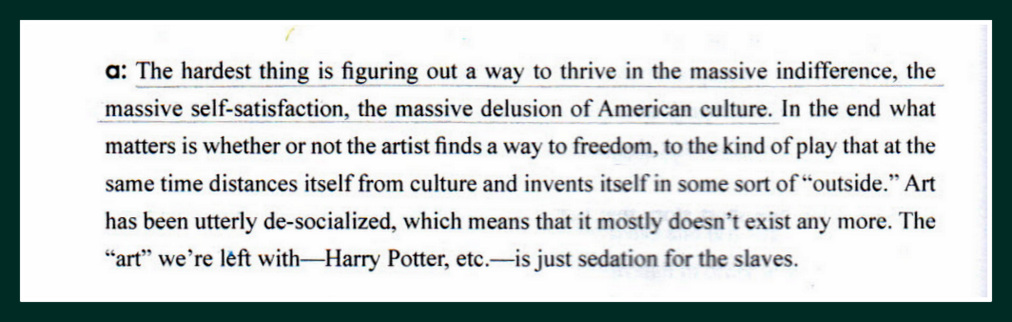
and to “What’s the best advice you might offer a beginning writer?” (I just ‘slipped’ and typed “writher”!), he replied:
“So my best advice is to read Nietzsche until you understand him and go from there”
thank you Curtis White 🙂
Aspects of Writing: The Beginnings – Conception. Inception.
The Beginnings: Conception, Inception
To be thinking about thinking about thinking the origins, the inception, where/when/how the movement-act, a specific verbal urge – that is, to write – conceives.
“To form or develop in the mind.” “To become pregnant (with child); to grasp seed.” No when, no how. No description. What? – it is a verb, it is verbal. Con– implying, for inference, a with-ness. Form requires relation in order to. Something grasped, taking shape, coming to be. Wombed – a gathering and a nurturing growth. Where? – the mind, the gut – of imagination and body.
–
Inception, then, a beginning, a change, necessarily requiring an other, an outside – entity or energy, movement/matter, to be taken, grasped, to form and develop. WITH.
–
Lodged “under the skin,” catching “in the throat,” sticking “in the mind.” Festers and swells. Obstructs and impedes. Reminds and welcomes or avoids. Alters, morphs, catalyzing change in and with the host.
–
Conception: to take with, grasp with, grow and develop with. To begin is to become.
–
Alter your position, feel what meets your body, even if only air. Step forward or back, turn – ceiling, sky. Nuzzle your nose inside of your neckline – inhale. Be with all that you are with. Take it in, work to grasp it, and let it grow and develop, in and with you. Change. Begin. Become.
Conceive.
Otherwise inception, impossible.
other Aspects of Writing
Aspects of Writing: Writing the Impetus. The Self-Reflexive.
The Self-Reflexive. Impetus.
The urgency, that is, the urging I feel in setting forth to compose, is dismantling.
In other words, the forcings that encroach, impinge and unleash within me when I’m ‘of a mind’ (experiencing the intention of) ‘to create’ is one of destruction, a defensive attack.
I am thus synonymed by sculptor, woodcarver, archaeologist.
One wants to undo the stories before they reach the page.
In order to find, discover, the figure of them, a more lasting (perhaps) form or shape.
To strip them of their ‘qualities’ or ‘style.’ Their manipulations. Creation as a straining of the weak, the falsifiable…a process in survival of the fittest, the more “true”(?) or apt.
Chiseling personal explanations and perspectival descriptions down to possibilities. Unraveling myths toward oracles. Discounting proofs into theories.
–
The impetus of writing evokes the motivation of doubt, the landscape is struggle.
“To be inspired” might mean to be activated by an experience accurately called “perfink” (David Krech), or, “perceiving, feeling and thinking at once” (Jerome Bruner).
Regurgitant feeling: investigation, analysis, interpretation – meanings attacking meanings, in hopes. In hopes that a perfink of “meaning” (a satiation of anxiety, terror, doubt) might prove indestructible – as a possibility.
–
The narrative, then (the verbal expression of a perfink), is a traffic jam of conventions, presuppositions, reality-views and solipsistic Gnosticism forged within the forging self; writing – as apparatus, activity, function – reflexes: brings self-world to bear on self-worlds in attempts to deconstruct automatic (as it were) constructions of perceiving/feeling/thinking – fighting, clawing, tearing against it with the information and energy of shared resources: language, “knowledge,” the usable past.
–
Clashings of systems, perfinking perfinks, violent internal skirmishes and acts of terror(ism) – a doing that attempts the undoings of doings – an otherwise endlessly insular, of unverifiable and infinite traces, activity known as self-reflexive –
– producing stalemates of exhaustion, individual paucities of supply and reinforcement, ourobourosian –
offering only extrinsic chances for momentary cease-fires – the artifact, figure, form of the battlefield, photographed in process and thus submitted – to critics, to readers, to colleagues, to shadows (i.e. to genuine Others) that it might become real (exist in relation, to be directly experienced), corroborated or dismissed by equally limited and idiosyncratic perfinking, outside – both in the world, and of it.
“the contest any artist has with his or her art: working toward a perception that is his or her mind’s peace.”
-Louis Zukofsky-
“the mind carries an austere
inwardness that will not put out its eyes”
-Laurie Sheck-
“Writing is a lonely business’ is both a dull myth and a material fact of the profession, one I happen to be temperamentally suited to endure but which doesn’t gratify my sense of what it’s for.”
-Jonathan Lethem-

-Robert Creeley-
Congruency: Of Delight in It
Thank you Superstitious Naked Ape for such a spot-on condensed rendition of (I think) what Pelevin’s Helmet of Horror evoked for me as well! Really readers – check these out together – incredible lucky spontaneous occurrences of “synchronicity”? Almost?

by The Superstitious Naked Ape
with the personal caveat that it may as well be named “The Self Machine,” “The Reality Machine” and so forth…
Umwelt
“Language is a thing: it is a written thing, a bit of bark, a sliver of rock, a fragment of clay in which the reality of the earth continues to exist.”
Maurice Blanchot

Entanglement
Getting back into A swing of things, I’ve missed the past couple of prompts for the wonderful mixed company of creatives that take part in the Friday Fictioneers (yes, please DO join us!). So here’s to restarting refreshed…

Entanglement
So this is our journey. No way out of it. Bound together, bound apart, bounded in. We call it “Situation.” Shared in common. Held by circumstance. Anything might bow us, but both will be effected. The cords behind, some measures of rest, and whatever comes next – it all impacts the song. Lucky for an other – no sound can be heard if there is only one, if our strings never touch. Though sometimes cross and crossed over, at others we vibrate one another to the sweetest hum. It happens together in our ever-bordered context – the space of our entanglement.
N Filbert 2013
Sentencing
“The truth is that large tracts of human speech are nothing but signs of direction in thought…”
William James
Composition

Approach the page with no idea. No secondness of reality or facts.
See what the words will do. Like spontaneous sex with your lover.
What happens next. If you’re lucky.
What words will come?
Look closely. Draw the pen near the paper. Remember, you’ve no idea, like what I’m writing. Language finding synonyms making thoughts. Perception in the body.
Something already in the clear, or on it. Never clear. Do you see it?
Don’t let the first mark frighten you, it is already done, everything coming after you can edit: crossing out, crossing over.
See the line? To chase or avoid, either way, impossible to capture or erase.
Look again – do you see it? Hover but don’t inscribe, what is it waiting there?
I’m not being mischievous or rhetorical, facetious or mystical. I want you to see what is always already there, predividing your canvas, filtering the open before you engage. What you cast out around you, the shadow of your general ‘self.’
See it there gathered at point of pen, shading back toward your physical hand and pooling around it? The absence of your presence forming incorporeality.
You are visiting here. Your shadow is the record. What you make out you make up. But it’s never the first word or the beginning line. Reality comes before you and spreads out, interfering and refracting the light you wish to use.
At times a bulky blot, at others barely discerned, evidence nonetheless that you are, in fact, tracing. Operating in a kind of cloud of substance, adding lines and loops, particles, threads.
They say art (and representation) began in shadows, with shadows – recognition of other and presence and beyond. Likely a myth that is true.
For starters, notice the outline, letting it outline itself/yourself, the visible ghost informing your are…
Now, since you’ve already overshadowed what’s next, begun what’s begun, press down and press forward, press on…
Emissions from the Helmet of Horror, novel mythology-cognitive-science-literature-art
“no one realised that the book and the labyrinth were one and the same…”
-Borges, The Garden of Forking Paths-
[as leaked from the skull stuck to Victor Pelevin]
“…progress is a propulsion technique where we have to constantly push ourselves away from the point we occupied a moment ago…the funny thing is that the concept of progress has been around for so long that now it has all the qualities of a myth. It is a traditional story that pretends to explain all natural and social phenomena. It is also a belief that is widespread and false.”
“If a mind is like a computer, perhaps myths are its shell programs: sets of rules that we follow in our world processing, mental matrices we project onto complex events to endow them with meaning. People who work in computer programming say that to write code you have to be young. It seems that the same rule applies to the cultural code. Our programs were written when the human race was young – at a stage so remote and obscure that we don’t understand the programming language any more. Or, even worse, we understand it in so many different ways and on so many levels that the question ‘what does it mean?’ simply loses sense.”
Ariadne: “…The diagram was called ‘the helmet of horror’ — it was written in big letters above the drawing. The main body of the machine was shaped like a helmet. And there was an identical helmet standing on the demonstration table — an ancient bronze headpiece, and underneath it a visor with holes in it curving back inside…Its lower section ran back inside the helmet through a slit in the middle of the face. And there were some kind of side plates too — everything was very old, green with age. It looked like a Roman gladiator’s helmet — like a bronze hat with a visor. Only this one had horns as well. They came out of the upper section of the helmet and curved backwards…the helmet of horror consisted of several major parts and a lot of secondary ones. The parts had strange names: the frontal net, the now grid, the separator labyrinth, the horns of plenty, Tarkovsky’s mirror and so forth. The largest element consisted of the now grid and the frontal net. It had two parts that were sometimes fused into a single unit. Its external part, the net, looked like a visor with holes in it, and its internal part, the grid, divided the helmet into an upper section and a lower one, so there was no way you could squeeze even the smallest head into it…the now grid separates the past from the present, because it is the only place where what we call ‘now’ exists. The past is located in the upper section of the helmet, and the future in the lower section…The helmet’s operating cycle had no beginning, so it can be explained starting from any phase.
“…start by imagining the gentle glow of a summer day caressing your face. That’s precisely how the frontal net, heated by the action of the stream of impressions falling on it, transmits heat to the now grid. The grid sublimates the past contained in the upper section of the helmet, transforming it into vapour, which is driven up into the horns of plenty by the force of circumstances. The horns of plenty emerge from the forehead, curve around the sides of the helmet and intertwine to form the occipital braid, which descends into the base of the helmet. There, below the now grid, the bubbles of hope that arise in the occipital braid are ejected into the region of the future. As they rise, these bubbles burst against the now grid, generating the force of circumstances, which induces the stream of impressions in the separator labyrinth. And the stream of impressions, in turn, is shattered against the frontal net, heating the now grid and renewing the energy of the cycle.
“It’s not always hope at all, it’s more likely to be fear and apprehension, suspicion and hate, all sorts of nonsense, in fact any of the cud that is chewed with such habitual stupidity…technically speaking it is correct to call them bubbles of the past. They are called bubbles because their constant tendency is to expand and occupy the entire volume of the helmet, preventing anything else from appearing in it and leaving no space or opportunity for the recognition of what is actually happening…since past is enriched exclusively with more past, the bubbles of hope consist entirely of past, they are simply past in a different state…
“The separator labyrinth is the most important part of the helmet of horror. It’s the place where everything else is produced out of nothing, that is, the place where the stream of impressions arises. And it’s also the place where the past, present and the future are separated. The past moves upwards, the future moves downwards, and the present, in the form of the stream of impressions, falls on to the outer surface of the frontal net, generating the cycle’s passionate desire to recur, so that it becomes a kind of perpetuum mobile…”
“That means that it’s past that decomposes into past, present and future? In actual fact the whole cycle is simply the circulation of now in various states of mind, in the same way that water can be ice, or the sea, or thirst.”
“…the ‘inside’ and ‘outside’ have no existence in themselves. They are generated by the separator labyrinth by the force of circumstances and from there they enter the horns of plenty, where they enrich the past, transforming it into the state of bubbles of hope. But since there is no ‘inside’ or ‘outside’ anywhere except in the horns of plenty, the stream of impressions can quite easily arise inside the helmet and fall on to it from the outside. And the same applies to everything else as well…never under any circumstances regard anything as real. The entire phenomenon is induced, like the electromagnetic field in a transformer…as far as I could understand it, the horns of plenty operate like enrichment units in a chemical plant. When it’s driven through them by the force of circumstances, past gets mixed up with everything else, becoming richer and acquiring value, with the result that bubbles of hope are produced in the occipital braid, go gurgling through the region of the future, are reflected in Tarkovsky’s mirror and perceived as the novel freshness of a brand new day.”
“In real life what you see depends on where you look…the word ‘change’ has no meaning…where you’re looking depends on what you see. Is that clear?”
“The future is produced from the past, so the further we go into the future, the more past is required to produce it.”
“Free will. Life’s like falling off a roof. Can you stop on the way? No. Can you turn back? No. Can you fly off sideways? Only in an advertisement for underpants specially made for jumping off roofs. All free will means is you can choose whether to fart in mid-flight or wait till you hit the ground. And that’s what all the philosopher’s argue about.”
“Always the way when you feel you’re just about to understand something important. It’s like the whistle of a bullet or the roar of an aeroplane. If you can hear them, it means they’re already zooming past you.”
“…a labyrinth comes into being in the course of any discussion with yourself or others, and for that period of time each of us becomes either the Minotaur or his victim. Although there is nothing we can do with this…there’s nothing we can do without it either…even the discourse itself can only come into being within the discourse. But the paradox is that, although the entirety of nature arises within it, the discourse itself is not encountered anywhere in nature and was only developed quite recently…Basically a labyrinth comes into being when you have to choose between several alternatives, and the alternatives are a set of our possible preferences, conditioned by the nature of language, the structure of the moment and the specific features of the sponsor.”
“Perhaps that’s the whole point. Not to think about where the way out is, but to realise that life is the crossroads where you’re standing at this precise moment. Then the labyrinth will disappear as well. After all it only exists as a complete whole in our minds, and in reality there is nothing but a simple choice — which way to go next…We’ve all got dead-ends. Only it’s not obvious straightaway, it just takes a little while.”
“The helmet of horror fractionates the one thing that is, into the multitude of things that are not. But since the helmet of horror is in no way the one thing that is, it is also one of the multitude of things that are not. And the things that are not may enter into every possible conceivable and inconceivable kind of relationship, since these relationships do not in any case exist anywhere except in the helmet of horror, which does not actually exist itself…An individual by the name of A may be a part of the helmet of horror worn by B, and an individual by the name of B may at the same time be a part of the helmet of horror worn by A. This is the final infinity in both directions, and often both of them are quite nice people.”
“The means by which for many millennia he has attempted to make himself real are terrible and foolish, like all the mysteries of his world.”
A remarkable new mythology from Victor Pelevin
(all above quotations arise from!)
 All my Words are Silent