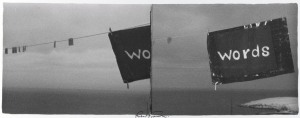
Writing it out : writing in

Into (and out of) the labyrinth of language

“there can be no fully articulated thought without symbolic embodiment…

language is the very stuff of which ‘ideas’ are made…

to separate thought from its symbolic manifestation would be as futile

as to try separating a mind from its embodiment in a human organism”

-Max Black, The Labyrinth of Language

“words are part of action and they are equivalents to actions”

-Bronislaw Malinowski-

            Sometimes silenced.  Pressured in channels.  A void creates a vacuum.  Fettered speech – often necessary but variant to “open” or “expressive” on a relative continuum.  To a purpose.  Carrying a message.  Responsive.  Reducing uncertainty.  Extrinsic.  Sometimes.

As if a balance of scales.  A fluid diagram – flow chart.  Internal at the individual end, external at the communicative social.  Between are many pages, many possible sounds.

If days go by.  When days go by.  After days without a feeling of spillage, a “seems” – the experience, for this writer, of unexpurgated, unconventional intrinsic release – that is, writer’s personal experience (a complexity of interactions – organism with environment and others) there ensues a kind of illness, like constipation, like perpetrated violence or censorship, like oppression – that, unless a leakage is allowed, some systemic crack, a private valve – writer risks implosion.  (Say – depression, frustration, resentment, anger).  Holding a forest beast under the lake.

Slipping out and away, writer beast finds a crevice or hollow, cavern or plain in which, from whence, he or she can reduce uncertainty, verbalizing observations and ideas.  As if life is the laboratory that would go unmarked and unnoticed without jotting tallies on a page.

Writing it out – writing in – a labyrinth.

Taking up the ball-point pen, dragging it along the surface of clean paper, is like turning the tap.

Hiss and sputter – tubes finding matter or substance, inciting energy – then flow.


I write about heaven and hell, the monsters here to there.  Of inscribing itself, the requirements of entity and imagined self or other.  The many, the few, and the plants and the beasts.  What air.  In the woods and the desert, the mind.  The heart with its loves and its rage.  Perpetual fears and the virus of mayhem.  I write about her and the children, of friendships and evil and time.  About death, about life, about learning.  In senses, in theories, in words.

It’s not difficult, I’ve just done it.  And you have provided the meaning, already.  Each term stimulating your “abouts,” descriptions and definitions, the semantics.  I craft words your eyes and ears compose commentaries to.  Little point to my telling.

Yet some of you read differently, perhaps listening.  Maybe wonder the about.  How it comes to be, what is signified for me, and why just so?


Creates conversation.  Your doctor can doll out the pills you receive and absorb, internalizing into your existent system.  Your god may tell you what you should do.  Your boss indicates how you should do it and when, friends and family surround you to be.

Not I.  I don’t want it to work quite like that.  I am spinning no story for you to follow along, no pattern upheld to your measure.  Writing it out in the labyrinth of language, I mean for exchange, for a wander – we enter, we leave the deposits we find, discover and fashion with so many hands, so many eyes, ubiquitous ears.

Write it out writing in, in the reading together, again, wending our way trading secrets and gems, co-constructing meanings and moods all to the tunes of language.


I step out of the water and dry.

The Labyrinth of Language
by Max Black

N Filbert 2012

This has been one of those weeks…children home sick from school, an art show to hang (see here!), school studies, and all the sundries of necessity leaving very little time for nourishing reading and composition.  Needed to set aside some time beginning this day.

The Pleasures of Reading : An Aspect : Multiplying Translations

The Pleasure of Reading

In other words (than what?  than which?) we all of us are readers, all of us writers.

That is a pleasure.

And all of us, always, doing both.  Simultaneously.


Speaking of my textbooks (were we?) – information sciences, developmental and behavioral psychology, reference services, librarianship / and the research to the side – physics, evolutionary biology, neuro- and cognitive sciences / my pleasures – novels, poems, stories, others’ blogs, visual, aural, literary artifacts / my relational – wife, children, family, friends, society, culture – gestures and vibes and dialogues and signs / my “self” – sensations, perceptions, formulations of these, reformulations, adjustments and maneuvers.

In other words, at all times, I am reading, even if only my lack of memorable dreams, or pulses and breaths.  And writing it all in actions, movements, responses, adjustments of speaking and writing and making.

It is a metaphor, obviously.  Perhaps.


Roman Jakobsen purported that “all meaning is a form of translation, and multiple translation (polysemy) is the rule rather than the exception.”  (I am translating his text just now into another con-text).

Wolfgang Iser’s (perhaps, anyway insofar as I am translating it here) concept of actual text (text as it is recorded by an author) and virtual text (actual text as read by a reader).

This is an aspect of the deep living pleasures of reading/writing for me.


An author/speaker/artist/scientist/mother/etc. has an urge or sensation – a possibility of action/behavior/message/idea (a virtual text) and translates it through multiple processes and levels of activity through some medium into an actual text/painting/utterance/experiment/recorded idea/sound, etc.  There it is in the real world – a physical artifact in time and space – added – if only for a moment.  Transforming (simultaneously) its maker into a recipient (translating a now existent text/sound/behavior/gesture/sculpture/experience for him or herself) and if any witness/participant/auditor/recipient or reader is in his or her environment they are simultaneously interacting (via translation through their own tools, language, perceptions, sensations, mood, etc) with the actual text, writing a virtual text (translating) of their own.

And it goes on.  And can be done innumerable times, this process, whether using an identical actual text over and over, or simply writing/reading life as it occurs, making it occur.


Paul Ricouer:  “stories are models for the redescription of the world.”  Possibly.  Or at least redescriptions (translations) of models for redescription.

Iser: “the relative indeterminacy of a text allows a spectrum of actualizations…literary texts initiate ‘performances’ of meaning rather than actually formulating meanings themselves…the reader receives it by composing it.”


Language, action, behavior as possibilities rather than certainties.


So that I can encounter with all I’ve encountered/experienced an actual text by psychologist Jerome Bruner translating these very quotes and contents with all he has experienced and translate it with the multiple translations of family life and being a human organism and novels and pains, poems and stories, paintings and laws, translated with data and education, emotions and animals, translating with you and a computer, internet, digits and bits, translating into…

a great pleasure of reading is writing reading

or, “a writer’s (reader’s) greatest gift to a reader (writer) is to help him become a better writer (reader)”

– Jerome Bruner (parentheses mine).


literary texts as “epiphanies of the ordinary”

-James Joyce-

Semantics

Semantics

Are words the poison?  The inevitable, unavoidable miscommunication?  75-80% of communication is “nonverbal,” yet according to the American Library Association even a corpse is a “document.”

What is it with semantics?  Is it sickness, like some original stain in brains such as ours – a terminal disease called “fabrication of meaning”?  “Second Sight”?

So that an arm movement, a particular gait, an expiration or whittled scar in rock will all be given significance?  All some addition, complexiting, a superadded content?

What is this penchant?  From where does it come?

It looks like the survival mechanism we think of (signify) as “prediction,” i.e. guesswork.

If we can surmise, invent, fantasize possible leads or outcomes…we’d have a better shot at preparing for it.

We make stories.

Often this is paranoia.

It’s the avoidance and terror of death.

Guess a metaphor for every existing moment, action, thing…and possibly you will survive it…know what’s coming and how to defend against or wriggle past.

Therefore, an alphabetical letter like a post-it note on possibilities, a warning-sign for danger, a diagram of fear.

Her head turns quickly – off put?  Offended?  Alert to me?  Tuned in?

Context.

Octagonal red sign at the corner…I stop.

Top sphere illuminated…I go.

“Crack!” I shift, swivel, flee.

One finger extended, my chest concaves, shoulders furl.

Drip, drip, my mouth begins to salivate.

Anticipation, desire, intuition, knowledge – all spawned in this erratic, sensationalized guessing.

Charlatans and spoofs, all of us.


“Interpreters,” “attributers of meaning” – he/she was so wrong, he/she isn’t listening,

hears, sees, feels what he/she wants (or doesn’t want – desiring either way) to.


Words are not the problem.  Signs, symbols, gestures, tones and moods – not the problems.


It’s the fear of death, our innate paranoia, our strict steeped instinct for survival.


Apathy might cure it.  Certainly suicide.  Some embracing of the facts.


It remains to be seen.


It will look like destruction.


These are only words.

N Filbert 2012

Putting Together

here it comes

So I’ve struggled a bit the past week or so with a plethora of projects: personal, family, parenting, school, commission work… mostly good things, deep rewarding things, and yet leaving me with a feeling that I have had very little time to simply create.  My wife challenges me often with the categories I concoct for myself between art and life, relation and solace, pleasure and responsibility, and by and large I agree that an artist’s life, a creative life, is a creative life, not a creative this-or-that, segregated activity.  And yet, nothing quite compares to a blank page not full of pre-existing questions or directions; an impulse externally unnecessary; a mark or word uncalled for.  It sometimes helps to think of things as stages, the “for now” syndrome that hope parasites.  But ultimately, I don’t quite feel “okay,” or balanced, somehow settled in my world, until time is available to sit at my desk, in my chosen or gathered surroundings, undirected but by what might rise from within.  Today I have plugged away seven hours or more at schoolwork, and granted myself an hour swept clear of such things.  The piece below is the result (click title or picture for text)

Putting Together

“Communication”

“Communication”

We, in our world, have a theory, a process really, that we call “communication.”  In various states of profundity it might also be referred to by “love.”

“Communication” is the process of signaling/decoding; saying/listening; writing/translating; touching/feeling by which we become aware of one another, about one another, of one another.

All things considered, “communication” is pretty important for us, though not necessarily to us.  While appearing more complex and refined than single cells or parts of cells vibrating under a microscope; more elaborate and extensive than a swarm of birds or school of fish, it hardly works as well.  As if certain sharp things and certain dull things cancel one another out.

Pitch, tone, palate and respiration.  Vocabulary, grammar, syntax.  Associations occurring in the brain, the glands, the organs, the body.  I’ve always thought of our existence as “fraught” and it never ceases to amaze me!

Amaze and astound, in no particular order.  As if “stound” were past-tense for “stand.”  Stopped-in-tracks-reeling-backwards.

There’s nothing to it really, we all do it, all of the time, innately, it would seem, given we could not survive without it.  And yet.  “Innate” wouldn’t be the right word.  Maybe “potential” as if capacities and possibilities surround every cell toward response.  And then.  What becomes.  Responsibility.  Of that interstellar stuff moving and extra-anatomical stuff too.  Kind of equals.

So we’re not necessarily “good” at it, and hardly possess a measure, everyone on equal footing at some point, depending on the context, depending on construction (of the possibles) and so forth.  It’s often accurately called “fuzzy” or “messy” – an entanglement of sorts in no sense negative.

I always liked William James – the jumble-up of him.  “Rich thicket of reality” he called it, a passage to get caught up in, sometimes snared, sometimes struggling, but ever in its midst, I suppose.

Lyn Hejinian once pronounced it “inexhaustible.”

I just wanted to mention…

“The argument would go something like this: reality exists; it is independent of what we think though it is the only thing we can think; we are a part of reality but at the same time consciousness of this fact makes us separate from it; we have a point of reentry (a ‘centrique happinesse’), which is language, but our reentry is hesitant, provisional, and awkward”

-Lyn Hejinian-

The Violation in Art

The Violation in Art


The trouble with artists, as I see it, is that they’re always breaking things.  Breaking out, breaking in.

As if their experience of the world (and in my opinion anyone might be an artist at any given time)…well, look at it like this…a human person develops perceptions and accumulates.  Artistry consists in these experiences transmuting, transforming and breaking out in alternate forms.

The world seeps, floods, sifts or bursts its way into the artist’s mechanisms of being, and their processing of said worlding breaks its way out, somewhere, somehow.  Often anywhere, anyhow!

Breaking in to us.

A person combined with their experience breaks out in a form through their hands or their vision, movements or mouth…the artifact then enters our perception, experience, breaking in to our own operations and proceedings…entering us.

Now you’ve a mingling of persons going on via artifact, motion or sound.

If you think about this, it’s threatening.  It’s criminal!  It’s viral.  And it can happen at great distances, even invisible, even in your sleep.  It may appear at first benign, even pleasurable, might mirror some part of ourselves (or so it seems) – because of its careless remove from identity toward object it feels safe and external…but how we take it in!

With anger or lusting or joy.  Voyeuristically, “privately,” or in a well-guarded institution.  Through literature, youtube, mp3s.  In deep thought or with staid attention, and passing glances or air-gathering ears.  No matter, there’s infusion, con-fusion, an intimate entwining going on.

And it is without-which-not on either side: construction/reception, speaker/hearer, writer/reader, dancer/audience.  We all become necessary and involved, creating ubiquitous perpetration.  And no one to accuse once it’s part of our experience, our (perhaps unwitting) invitation.

Like cancer or nutrients, an other-marked entity joins with our own joining to theirs in apprehension, a collusion of worlds and of persons.  An act in which all are responsible: reciprocal engagement of voyeuristic and combinatory intimacy, breaking open, breaking in,

breaking out

breaking through

a delicious and permissive crime.

Writing: the Margins

This slideshow requires JavaScript.

Writing: the Margins

“All words run along the margins of their secrets”

– Susan Howe –


Now we are getting somewhere.  Now we can go ahead and believe in telling and in being told.  If “every word runs along the margins of its secrets.”  If so, (and it feels truthful, even if untrue) then…

there might be other margins, or perhaps every margin limns its contents and its secrets?  Perhaps, then, our senses, and every limit of our perceptions “run along the margins of their secrets,” like our cells and bodies do.

That “perhaps” means here “possible” – an enormous margin full of stuff and secrets.  I.e. seen and unseen, known and unknown, believed and unbelievable, etc.

And if “Limits/are what any of us/are inside of” is truthful of Charles Olsen to utter, then we might be everywhere up against the margins of the limitless.

Speaking practically, a margin is variable, and bodies and language (synonyms of a sort) are more variable than variables.

So to say, we may indeed (in our actions of doing and making, saying and thinking – signing and gesturing) be communicating.  That is, it is possible.  Words running along their margins of secrets, senses apprehending along their own secret margins, the boundaries porous and variable: something might be meeting there, might be weaving, might be, as it were, com-prehended (apprehended together in some so-called secret way)…co-mmunication?

If language, in its way, defines the social, our context, like skin, for participation in world…connectivity, sharing in common, is not only possible, but necessary, and the secrets, the ineffables, the private, what we thought of as incommunicable, is clinging there, infused with the margins, the borders where we interact, transact, have (as it were) our being.

Therefore

“it is not infinite.  Even infinite is a term”

-Louis Zukofsky-

by which I mean all our words signifying –lessness: limitless, timeless, meaningless, objectless, and so forth, limn their mysteries as much as the constant traction we enact with our names.

Lines wide enough for all of us to traffic in, and obviously very thin, perhaps transparent – we are dancing here.

Feet and minds, hands and mouths ever each right where they seem to be and also where they’re not…marginal movements…co-here-ence, always presently together, secret and exposed.

Perhaps and possibly.

N Filbert 2012

So Rich and Rewarding in their Own Unique Ways!

Favorite sourcings of mine

and pleasures

both INTENSELY recommended for readers and thinkers alike

(are those one and the same?)

Telling Our Stories

This slideshow requires JavaScript.

Telling Our Stories

After all, it is language, this story.  This telling of you, of me, of our feelings and years, whatever we’ve done.  We are just speaking, really, creating from language our world and our children, our works and our actions as if we remembered.

I can’t see the harm in it.

I say I remember, here looking at you, that first time in your eyes, whether 18 or 40, when we may have sat facing each other or entwined, as if we’d first met and must absorb everything.  How large they seemed, how blue and soft as rain, how far I could swim there as if building a nest.

I don’t see the danger in using our language to say so.  In making up stories, alone or together, about us; our world and our selves, what we think.

After all, it is language we share.  As you bend at your work, your collar reveals a fresh sentence, your skirt a painting of terms, in your flesh all these stories I study to learn.  Of your breast and your elbow and hair.  The nape of your neck exclaims and your scars everywhere.  What the poet said, also with words, combining verbs and adverbs and nouns: “Your body is a book of thoughts that cannot be read in its entirety.”  Just words, but I keep them and sing them again, I can’t see the harm in the trying.

I love you with terms of my body.  I sign them to you when it’s dark.  It is language, oh yes, and you hear me.  We read with our skin.  Typography refers to impressions.  You impress me, even as I Braille what I need.  How else might we weave what is we without terms and strokes or gestures?

Only language, after all, that we borrow, I get it.

But where is the frailty in trying?

I read and I read and I read what you tell, ever growing a Talmud of comment.  I notate, I argue, I vent.  Then repeat.  I praise and I question and soothe.  You likewise make of my verbiage a stream; a spring from far peaks that dissolves to a delta.  What should we call what we do?  Relat-ivity?  Our capacity to engage and to meet – to relate?  Communication?  Always co-, ever with, filling munitions and messaging, our vocation?

To say, to listen, to hearken, to spell.  Here we tumble and thicken and age.  Her we interpret, reply and enrage.  Here we bind ourselves, it is language we keep using, keep finding, continue to tell…

“………………..Even in sleep

our bodies seek each other, your face the moon

lighting my dreams.  And by day, scenes beyond

untanglement.  Tell me my story, love;

how could I know it, we are such knotted things?

-Philip White, from Aubade

Signs

This slideshow requires JavaScript.

Signs


We wanted love.  This sentence has no meaning outside a sentence.  We wanted a multitude of words.  Love was to become the quarrying of ourselves, emerging from a completely different side of the narrative…Representing ourselves to ourselves was an unmanageable task from the beginning.  To continue being a reality while simultaneously becoming its sign that dissembles nothing, only relentlessly elevates itself in a continuous shadow –

-Arkadii Dragomoshchenko-


There was no doubt we wanted.  What it was that we wanted, exactly, was another matter.  We wanted love?  Perhaps.  Love made from words and signs and gestures.  From the beginning we had trouble representing ourselves.  Being a reality while also signifying it and being its addressee – inveigled us in a continuous loop.  We needed another view.  From a completely different side of the narrative.

Maybe we wanted to drink reality to its dregs.  We wanted love.  Someone who could read the being and its signs and comprehend its address.  Someone to help interpret the loop, quarry the signs, chart and map the shadowy spiral.  We wanted a multitude of words.  Words we’d never thought of.  Never heard before.  Synonyms and antonyms to set apart our signs, that we might, perchance, see who we are.  Learn, not just be.  We wanted love.

Loving ourselves was clinging to continuous shadow.  Ourselves always just ahead of us, being, quarrying experience, fabricating new signs, dissembling nothing.  We didn’t know, anything.  We wanted love and a multitude of words, of gestures – significations of action and matter – we wanted to be real.

Your side was completely different.  There you were – being, assembling signs, dissembling words I thought I knew into paradoxical meanings.  I’d see a sign that seemed familiar but the language was foreign, the reference obscure, of exotic materials.  Where were you quarrying?  I was stunned and fascinated – we could make such similar things of our surround and within – yet pointing in apparently opposite directions!  How could this be?

We wanted love.  I followed your signs, tried to tell you what they meant.  We wanted for multitudes of words.  You sought to explain, what with the being, the source, the signs and address,  indicating your shadow, not mine.  I, forever chasing the shade of your dress.

We wanted for love and showed each other signs.  We gestured and addressed our bodies and songs, put on shows of ourselves for each other.  Here are my banners and pennants.  Here my consistent mottoes.  Here the images we keep – representations of ourselves like lost memories.  Here our directions and contents, graphics and readings.  Signs, signs, and a multitude of words.

We began telling one another their stories as we read.  Replete with new words, new signs and misreadings.  This did not often go well.  With each sign that we made we were reading the last.  We couldn’t keep up, swimming in continuous shadow.

A multitude of loving and words.  We believed we wanted reality.  We decided to quarry together – our insides working into a shared surround.  We disagreed on its representation and agreed to post personal options.  We grew confused and crowded with signs and gestures.  Grabbing some of these, we started swinging, thinking ours might outlast the others, might prove “right,” win out, or be “true.”

Our signs began to shatter as our words and gestures dissembled.  We established picket lines and separate camps.  We fashioned more signs with blazoned slogans of ourselves and our views, losing them inside our shadows.  We decided to climb.  Perhaps a view from afar, or you’ll be off on expedition.  We located a guide.  Who seemed to think all of our signs were true.  We looked again and could read that we wanted for love.  Our valley was riddled with signs.  Our guide interpreted gestures the same.  Words of pain, words of fear, a multitude of words.  All quite similar but in our own languages.

We wanted love, he said.

Someone to read our beings, our signs and receive their address.  Someone to help interpret our loops, quarry new signs, and map our spiraling stories.  We wanted multitudes of words and we had them.  Words we’d never thought of nor read.  Words replete with variant meanings and references.  Synonyms, antonyms distinguishing our signs, redirecting our shadows.  If we listened and looked, and with care, he said, perchance we might see who we are, being.  And learn how to be.  If we wanted for love, we had it, he said.  Just look at the signs.