This. Interesting. Day.

Interesting:  it will come, whispering in your imagination that the English interest comes from the Latin inter esse, literally “in-between-being.” – Gunnar Olsson, Abysmal

“something must have changed” – Samuel Beckett, Malone Dies

I guess I just decided to let something else happen…

I suppose I decided

insofar as we do

to let something else

become…

“This is what I’ve decided.  I see no other solution.  It is the best I can do…

…that little space of time, filled with drama, between the message received and the piteous response…

 …Of  myself I could never tell, any more than live or tell of others…”

Samuel Beckett, Malone Dies

distrusting human plans

Confusion : Fusion-with

azure-liminal-sky

The light is good.  I’m confused.

What “good”?  “Good” for what, and in relation to?  Diffuse, azure atmosphere of oncoming dusk.  Chilly, not cold.  Nearly pleasant, yet crisp enough for shiver and grip.  Unsteady, trembling grasp of pen, a striving for control mated to its lack.

Hardly daylight.  Liminal.

I would like to express.  What I do not know, perhaps am even unable to.

This is why I approach a page – blank, blind, lined, empty – in “good” light and confusion.

Fusion-with, what?  Chemistry, alchemy, biosphere, organism, complexity, surround.  Others’ emotions, experience.  Possibilities not actualized, each swarming potential of vocabulary, gesture, signification – line, sign, mark, motion – converging formulation, conveying contrivance / re-cognition. What is not, hovering about each “is.”  To write.  To write (only) this.  When…

Once begun.  Light, terms, cursive.  Blue Bic ball-pointed pen.  Moleskine substitution and human and language and in- and ex- perience and some =, some theorized equation of functions and results.

January 29, 2017.  Nathan Wayne Filbert.  5:44 pm according to a Centrally Standardized Timepiece, an Apple product, arranged amidst pages from many centuries and sources, composed music sounding from the last, temperatures…”actualities”?…amid vast, incomputable com-possibilities.

If Nathan had not been “this one,” had not begun with a “T” or a “T + h + e” in this light, in this almost comfortable, discomfiting condition, in this notebook, with this pen and its ink at this time on this bastardized quality of paper, among such circumstances and scenarios, amid these relations as a father, a student, librarian, scholar, male – of this certain (arbitrarily standardized mandatory and countable) age, intimately (accordingly – to strata not set by either) coupled to- caring for-, concerned with-, worried by-, wishing for-, happy about-, and so on…

this word or letter at this time in this space with these extremely idiosyncratic and unlikely determinate positions and scenes in a surround incrementally rare and unreckonably accidental…

“The light is good.  I am confused” leading itself its own very peculiar particular wave way toward each next and next co-dependent with innumerable constituents and counterparts yet occurring here, now, 5:54 pm CST in Wichita, Kansas in United (are they?) States of America (wha-? why? how? when?) 2017 (by what calendar and whose and wherefore?) at an intersection outside of a centuries-old and decrepit “house” it calls “home” (why? wherefore? from whence toward and…?)…

Indeterminate.  Indecipherable.  Unreasonable and incalculable.  Not accountable or even conceivable…but IS (apparently).  Simply IS, what is written, at this time, in this place, by this organism, of these relations, in this surround, at this moment, occasion, “actuality”…

…as it happens… as if

“The light is good.  I am confused.”

Displaying FullSizeRender.jpg

Michel Foucault: “Speech Begins After Death”

.

..does the pleasure of writing exist?  I don’t know.  One thing I feel certain of is that there’s a tremendous obligation to write.  This obligation to write, I don’t really know where it comes from.  As long as we haven’t started writing, it seems to be the most gratuitous, the most improbable thing, almost the most impossible, and one to which, in any case, we’ll never feel bound.  Then, at some point – is it the first page, the thousandth, the middle of the first book, or later?  I have no idea – we realize that we’re absolutely obligated to write.  This obligation is revealed to you, indicated in various ways.  For example, by the fact that we experience so much anxiety, so much tension if we haven’t finished that little page of writing, as we do each day.  By writing that page, you give yourself, you give to your existence, a form of absolution.  That absolution is essential for the day’s happiness.  It’s not the writing that’s happy, it’s the joy of existing that’s attached to writing, which is slightly different.  This is very paradoxical, very enigmatic, because how is it that the gesture – so vain, so fictive, so narcissistic, so self-involved – of sitting down at a table in the morning and covering a certain number of blank pages can have this effect of benediction for the remainder of the day?  How is the reality of things – our concerns, hunger, desire, love, sexuality, work – transfigured because we did that in the morning, or because we were able to do it during the day?  That’s very enigmatic.  For me, in any case, it’s one of the ways the obligation to write is manifested.

This obligation is also indicated by something else.  Ultimately, we always write not only to write the last book we will write, but, in some truly frenzied way – and this frenzy is present even in the most minimal gesture of writing – to write the last book in the world.  In truth, what we write at the moment of writing, the final sentence of the work we’re completing, is also the final sentence of the world, in that, afterward, there’s nothing more to say.  There’s a paroxysmal intent to exhaust language in the most insignificant sentence.  No doubt this is associated with the disequilibrium that exists between speech and language.  Language is what we use to construct an absolutely infinite number of sentences and utterances.  Speech, on the contrary, no matter how long or how diffuse, how supple, how atmospheric, how protoplasmic, how tethered to its future, is always finite, always limited.  We can never reach the end of language through speech, no matter how long we imagine it to be.  This inexhaustibility of language, which always holds speech in suspense in terms of a future that will never be completed, is another way of experiencing the obligation to write.  We write to reach the end of language, to reach the end of any possible language, to finally encompass the empty infinity of language through the plenitude of speech.

Another reason why writing is different from speaking is that we write to hide our face, to bury ourselves in our own writing.  We write so that the life around us, alongside us, outside, far from the sheet of paper, this life that’s not very funny but tiresome and filled with worry, exposed to others, is absorbed in that small rectangle of paper before our eyes and which we control.  Writing is a way of trying to evacuate, through the mysterious channels of pen and ink, the substance, not just of existence, but of the body, in those minuscule marks we make on paper.  To be nothing more, in terms of life, than this dead and jabbering scribbling that we’ve put on the white sheet of paper is what we dream about when we write.  But we never succeed in absorbing all that teeming life in the motionless swarm of letters.  Life always goes on outside the sheet of paper, continues to proliferate, keeps going, and is never pinned down to that small rectangle; the heavy volume of the body never succeeds in spreading itself across the surface of paper, we can never pass into that two-dimensional universe, that pure line of speech; we never succeed in becoming thin enough or adroit enough to be nothing more than the linearity of a text, and yet that’s what we hope to achieve.  So we keep trying, we continue to restrain ourselves, to take control of ourselves, to slip into the funnel of pen and ink, an infinite task, but the task to which we’ve dedicated ourselves.  We would feel justified if we no longer existed except in that minuscule shudder, that infinitesimal scratching that grows still and becomes, between the tip of the pen and the white surface of the paper, the point, the fragile site, the immediately vanished moment when a stationary mark appears once and for all, definitively established, legible only for others and which has lost any possibility of being aware of itself.  This type of suppression, of self-mortification in the transition to signs is, I believe, what also gives writing its character of obligation.  It’s an obligation without pleasure, you see, but, after all, when escaping an obligation leads to anxiety, when breaking the law leaves you so apprehensive and in such great disarray, isn’t obeying the law the greatest form of pleasure?  To obey an obligation whose origin is unknown, and the source of whose authority over us is equally unknown, to obey that – certainly narcissistic – law that weighs down on you, that hangs over you wherever you are, that, I think, is the pleasure of writing…

…I’m not an author.  First of all, I have no imagination.  I’m completely uninventive.  I’ve never even been able to conceive of something like the subject of a novel…I place myself resolutely on the side of the writers [in distinction – Roland Barthes – from authors] those for whom writing is transitive.  By that I mean those for whom writing is intended to designate, to show, to manifest outside itself something that, without it, would have remained if not hidden at least invisible.  For me, that’s where, in spite of everything, the enchantment of writing lies…I’m simply trying to make apparent what is very immediately present and at the same time invisible…I’d like to reveal something that’s too close for us to see, something right here, alongside us, but which we look through to something else…to define the proximity around us that orients the general field of our gaze and our knowledge…

So, for me, the role of writing is essentially one of distancing and of measuring distance.  To write is to position oneself in that distance that separates us from death and from what is dead…I’m in the distance between the speech of others and my own…In exercising my language, I’m measuring the difference with what we are not, and that’s why I said to you earlier that writing means losing one’s own face, one’s own existence.  I don’t write to give my existence the solidity of a monument.  I’m trying to absorb my own existence into the distance that separates it from death and, probably, by that same gesture, guides it toward death…

I’dd add that, in one sense, my head is empty when I begin to write, even though my mind is always directed toward a specific object.  Obviously, that means that, for me, writing is an exhausting activity, very difficult, filled with anxiety.  I’m always afraid of messing up; naturally, I mess up, I fail all the time.  This means that what encourages me to write isn’t so much the discovery or certainty of a certain relationship, of a certain truth, but rather the feeling I have of a certain kind of writing, a certain mode of operation of my writing, a certain style that will bring that distance into focus…

Foucault saisi par la révolution - Vacarme | Michel Foucault | Scoop.it

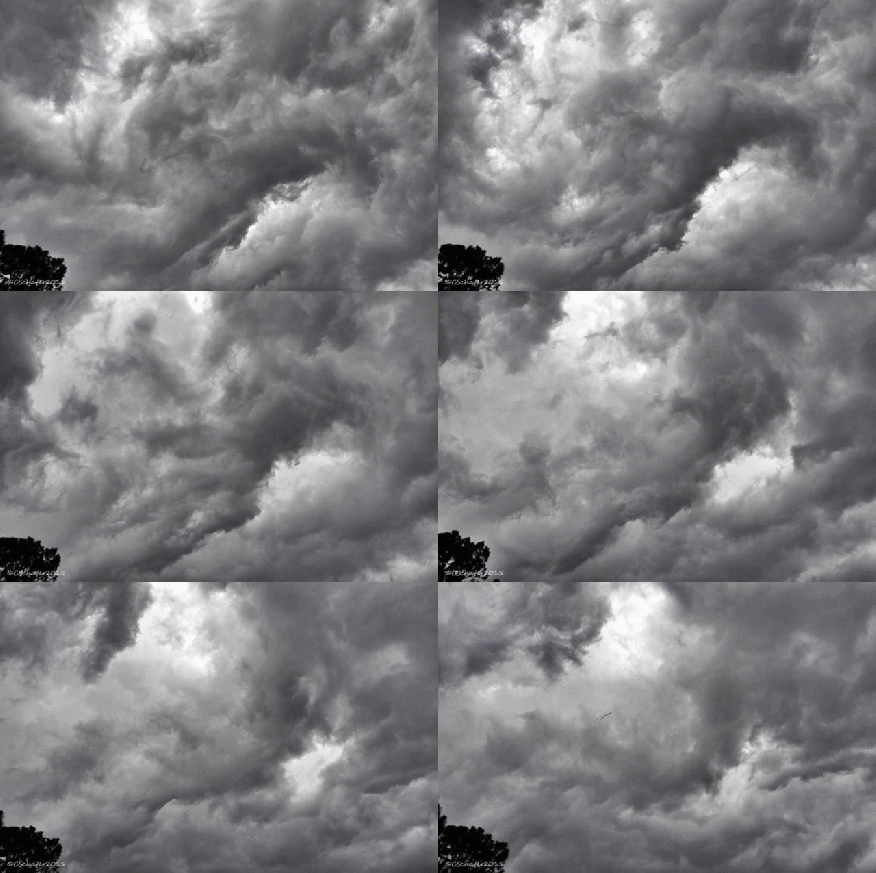
Cloud Fragment #3

cloudswirl.gif

To swirl.  There.  He said it, stated intention, directly.  To be lost, languishing (anguish is in there), full of lose and seeking, squirming, rutting, snuffling about.  Scent search of what?  Or not what quite, but how, now?  The unknowable, uncertain, which lies beyond perhaps, inaccessible, indeterminate, resistant to decipher, discretion, or decode.  He plies.  Ruin of movement, beyond conceit and loosely bound, tearing terror of graspage.  An infinity of words, or if not, many disordered magnitudes more compossibly complex than he –wrecked in kind with troubles of time, reductions of selection.  What means, all knotted in already-known.  A scumble then, without, arms treading, legs a-flutter, cognition confused in the mass, mess, unaccommodated, arranged re-arranging, affective and effecting, assaying never fully, nor enough, insufficient temporals and scope, shortfall of finitude, unbecoming, irrealized, incomputable surround.  To swirl or swoon perhaps – intends eccentric excentricity, without with-in, within outside and othering.  Immersed, submerged, tumbling almost-struggle, almost-drift, thoroughfare and passaging, limning swaths of runnels, channels, margins.  Copiously coping, how would he go?  What are the  motions lesser than stir and more absorptive?  And what of the when?  Who now, where now, how when?  Confusion, then – confusion, swooning and swirl.  A wriggling receipt, some commingling transference transmitting, attention intending undoing, origins ever receding, irremediable in rot and excess, dismembered invention – begin – excise and evince, glide of erasure and uncover, indiscernible activity of process, waving particles, particular waves, currents and tropes, passively permeable patterning passageways [not that!] imperceptible part-i-cipatory breakage and shatter, dispersion deconstructing refusal.  He ruins, inevitably.  That stands – there.  Unworking integration every angle or approach, from inside, decay, a desiccate and undone doing.  Mismade by allowance, a scribbling palimpsest or correction – be cognized, be written, be spoken, transcribed – he wails into unruly, disruptive, erupting fluid floodings of voiding, of nothing.  Not afloat, asail, aswim.  Neither drowning nor submerged.  Nearly saturate with swallow and exhale, a lineament on empty, some faulty trace.

Unstillable

scribbling

“Pangs of faint light and stirrings still.  Unformable graspings of the mind.  Unstillable”

– Samuel Beckett –

Let’s loiter about here a little, as if language were lakelike, locatable, alive enough to lollygag loose within.  Perhaps not.  Perhaps it is nearly always just-becoming.  Perhaps nearly all, nearly always, is thus: just-becoming – liminal lineaments languishing-then-livened, languishing-then-livened, “again” we might say, designating (de-term-ining) a balance to enlivened.  How so?  Why so?  By what author(ity)?

Unstillable.

“In the madhouse of skull and nowhere else” (– Samuel Beckett).  Is that so?

“Skin has no choice but to converse with the world…thin, ignorant borderland of skin…myself all trespass, misunderstanding, translating, translating…” (-Laurie Sheck).  Is that so?

If words were invented with sense.  To “make sense” between one and an ‘other.’ 

What if words ARE THAT?  Connective contours between.

I am inebriated, my willingness loosened to expression, though it might ruin me (like language) and I stare (Dostoevsky – ‘Myshkin’) “intently” into Mikhail Bakhtin’s face, his specific eye-gaze, and say:

“Is it the case that words are ‘meant,’ are ‘formed,’ are breathed, are…constructed, are…utilized, to be tissue woven between ‘me’…and ‘you’?”

Do we… speak, say, expire back and forth… to become?  To string and weave lines, flows, strands, threads, that might forge or invent co-respondence, texture, significations combining you and myself into WE?

But Bakhtin is dead, and cannot answer.  Mikhail Bakhtin does not have the capacity to co-respond.

…like Beckett, Blanchot, Plato, Montaigne, Pessoa, Pascal, Wallace or Euclid, Bulgakov, Heraclitus, or Celan (as with any and all dead!) he emits traces (tracings) with which I can consider, decipher, and interrogate in and within my ‘selves’ but not between

What might this ‘mean’ – between anyone?  Nothing.

It can not, has no opportunity to, delineate or circumscribe, draft, figure or shape any relation.

Sign emitted, call evoked, death, and then text as silent partner.  Prognostic retrograde delineation.

Bankrupt, impassible, impossible, communique.

The decoding of words as communication, connection?  An imaginary.  A handling of terms.  Inventing, devising, originary.  With whom?  Where?  How?   Hint and vestige, remnant and sketch, scheme and fabrication, inkling and outline.

Unstillable. Unformable graspings of the mind.  Is that so?

If we’re limning the liminal now, let’s loosen the letters and slacken the sieves.  Lasso and lounge, scatter and scrape, together (to gather) – a scintillate sense – sporadic sparks, succulent scenarios – exist for enlivening language, whatever limited lust lies therein – if language is locatable and not merely modal mechanics?  A modicum of music then, some scrap of sonority, some lingual litmus ‘making sense.’  Whatever.  Possibility, potential, particible particulars…

“THE TEST IS COMPANY”

“If there may not be no more questions let there at least be no more answers”

– Samuel Beckett, Company

“We must not die: kindred spirits will be found”

– Viktor Shklovsky –


Cloud Fragments #2

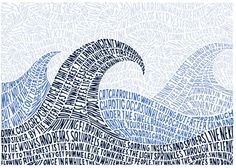
oceanwaves.gif

What the whispers, wreathing wraithwords, wisp-whooshing ways, weave-unweaving willful wreckage.  Watery-unwound wrapping-about while unwrapping wishful rending renderings.  Wronged construals in warped wrestlings – reachings, wrenchings – resiliently resisting.  Wranglage, wronguage, writ.

Remains for re(sign)ation.  Re-as(sign)ment.  Relinquishing rest or rectitude.  Repentant writing.  Riddled and recoiling, recombinantly removeable recklessness.  A raucous rancor irregular, irrational, and ever ill-advised in its deviant devising.

Devastating detour: devouring the decrepit, dissimulate, divisable devisor of description.  Descry the dilettante, the decayed decoding at diminish.

Wrest a return: remandering mayhem, maladaptive remainder.  Roping radicals round reason – irrational redescription in rascally remorse.  Mismade and mismanaged.  Wranglage, wronguage, writ.

-toward the New Year

Haunted Man: I am: the possession

“quiet field without possession”

Laurie Sheck, Captivity

wavewords

I am an ocean of signs.  Of a womby surround – undulate, viscous, discombobulate, obscure.  Tremulous quarks of murky markings and inference, connotative particles, confused, ill-defined, and indifferent.  Instigative convolutions, a potentia of concatenation and combine, cations and anions, dispersive attract.

Filled with words.  Prescriptive, disruptive, chaotic, coherent.  A turbulence transposing subjects, predicatively morphing, an aqueous slurrage of verb, vim and weave.  Compositive, foreign, constitutive terms.  Not-I.  Of Other.  As shapes and colors, sounds, concepts, any all perceived – no idgit of me, all permeable outside – Otherness, environ, cocoon – borrowed, received (or rejected?), an elusive collude.

Signifiers swarm me.  Inherited meanings, genetic loom of semiotic loops and swirls.  Who begins?  No ex nihilo.  All arrange, revise, adapt.  We’re composed.  I of an ocean of signs.  Language and impulses, instincts and codes.  Ellipses and notions imposed.  Undifferentiate, senseless, stirred by experience – a cacophonous chorus of bones to my suture.

Oral, aural, textured and gestured, I swim and I sink, flux in the float.  Fragments and fractures, compounds and bonds, links and erasures.  Malformations.  Dis-ease.  Some viral, some blocked, unusable and ill-conceived, undone, or aborted.  Indisposition. Swim on, slurry substance, amalgam of shreds, resist and desist, copy and swallow.  I choke.  I chortle.  What makes “mine”?  Just a word, (yet another), from whence and from where we don’t know, but not “us” (neither that, nor this keystroke, this breathy design, dasein, without ownmost).  Even a name is built upon countless.  Other.

Epi-, meta-, arche-, unknown and unknowing, interpreted through mediated mattery fracas, encompassing commotion, tempestuous din, innately ordained.  But not-I, freak iota, insignificant smallest, author of none.  No one.  No thing.  No not-I.

Quavery, wavering, components of signs, my birth-sea and umwelt, disjoiner and fabricate mush.

This become, in this swelter, this wrap and unravel.  Efface and inveigle a ubiquitous unique.  I am drowning, a seaway of signs.

Haunted Man

[from a crumpled writing found under a car seat among additional trash, transposed to typing as a record of a mind’s mayhem and mistakes]

“Deliver me, prays the haunted man.  Therefore…”

Gunnar Olsson, Abysmal

I am Dostoevsky and I am Beckett.  I am Hegel and Heidegger and Holderlin.  I am Kafka.

I am not good enough for any of you.  I do not merit your time nor your attention, affection, sensibilities, your human talents, or your care… no conceivable reason to mention “love.”

But I love you.  I am the one who loves you.  The one who writes.  Who writes these words.  The haunted one, the Reader, the Librarian; the Lover, Scholar, I am me.  I love you.  I am haunted.  Words runnel through me, and with them thoughts, and with them feelings, and with them meanings, which means…nothing.  No matter, no space, no time.

The “haunted man” is a passage, a passing, a ‘type.’  Of no import, little reality, barely occurrence.

*

I am Blanchot, am Homer, am divine Scriptures, and Shakespeare.  Simply, small-ly, in my own way, this very general way, I am what humans do with language.  For one another, with one another, to one another, as.

*

Yards and houses, flesh and voices, signs and symbols, marks and sounds, music and rhythyms and gestures, as attempts to conjoin – join and connect – survive, discover, endure, be, become, in-volve… With no idea.  Or ideas that continually prove false and faulty.  Elaborate records of revision, perhaps better inscribed as simple songs of effort.  Urges only TO BE, and that, TO BE CONNECTED.

But what do I know?  I’m Pythagoras, call me Ishmael or Ahab, Everyman or Whatever.  I’m out-dated.  Assign me a number.  I don’t really care.  I really care.  I am here, and I, (at least) re-present, or present again, or presence, a sort of being.  Such as it is… with no “REAL” way to evaluate, estimate, “tell,” or “express.”

*

Satan, then, Jesus, Joyce, Proust, Alexander.  No matter, no space, no time, only IS.

A “tradition” (as it were, in our own words).  We.  Its + That + This.  US.  Humans strangely (apparently) in environments.  These ways of thinking, of being, of behaving and operating, of supposedly surviving (but with what evidence?  WHO or WHAT might know?).

How might elements arranged thus & so, survive?  I am Nebuchadnezzar, Mohammed, Hammurabi and Ishtar.  I am ab-original.

I am Nothing.  Everything.  No one.  Me.

Each time.

Each press of the pen: “Hello – ‘here’”

*

As simply as I can construct it (all of it, any of “it”) it goes something like this: accidents occur, accidents are weird, and accidents give way.

I, like all other(s), an accidental novel.  Occasional and Whatever.

WHAT HAPPENS TO BE… at any given point-of-measurement (i.e. as far as we have a capacity to render, sunder, and effect – “Reality” (for us)).  Some quirky, unlikely, ridiculous, painstaking, odds-massively-against, and over-dramatic assessment of a certain sort of being-in, being-with, co-occurrence, happen-stance, we fabricate “human.”

TO BE SOMETHING

(organism, constituent, element, participant, activity)

*

In many other words (for the sake or ability of ‘them,’ ‘it,’ ‘all’) I may as well be.  Be Hallie or Ollie or Aidan or Rhesus.  Chief Joseph or Samson or Ghandi or Jordan.  Be you or Sara or Maya or Jimmy John.

“no matter.  Try again.  Fail again…” no matter.

THIS TOO SHALL PASS.

“the venom of the serpents were within him”

Gunnar Olsson, Abysmal

HOW SHOULD I KNOW?

*

And so what if I were Bernhard or Bach, Napoleon, Attila, Montaigne or Dorothy Parker?  If I had the ammunition or energy (and weaponry?) – the rhetoric, the nerve, or the madness.  L. Sterne, Nagarjuna, Hafiz, JL Borges?

“No matter.  Try again.  Fail again…”

Titian, Beethoven, Plato/Socrates, Palestrina.  Michelangelo, V. van Gogh, and Chuang Tzu.  You.

“No matter.  Try again.  Fail again.”

(hardly Beckett)

Badlands #1

I didn’t come back.  Something stayed on in the far.  Apart from the wires and the noise, “connections” and net-works.  Somewhere away.  No mistaking it was I who drove home, unlocked doors, and arrived.  I who functioned and served as a placeholder.  Yet I’d stayed in the cold and remote, the far reaches.  Away.  I haven’t returned, though something sure did – no one noticed but me.

It’s alright, there is room.  Space to breathe and to think, space to listen.  Apace like beyond or forgotten, the lost, misremembered – like that I was left or retained.  On I wandered, as wondered; I pondered and roamed, but I did not come back, that I know, not this time – too much risk without safety to “be here.”  I don’t want to – not here – no where, no now, no sure thing – not “that.”  I’d like to be other, undone, in the wild, separate, immersed, and another.  Not me.  Not this.  Not here.  Not now.

So I stayed and I didn’t come back.  No one noticed.  Alone, I began to combine and consider.  Correspond and co-question the side of the world the world was on.  Difference side, or an other, not a me or an ours or an us.  Just a world.  I renamed there, all one, even while I returned and took care of.  I escaped.  Not me, only them, not I, just the others, who cares? – perhaps no one, not me and not them and not elsewise.  I am gone.  Gone unnoticed.  It’s okay, for who cares?  As long as I’m holding my place, and fulfilling – a father, a worker, a lover, a friend – no one cares if I never came back from the forest and sky or the wind and the cold.  The dark places.  No one knows, no one cares, nor do I, just I know, that is all, that I didn’t.  Return.  Rejoin or sync up.  No, not I.  I’ve stayed far even while it’s my body or figure that fills up the places and manners I was.  I am not.  And it’s fine, doesn’t matter, why would it?

I blink with the breeze o’er the road.  Lodged in swift crannies and caves, dropped in canyons, and spread through the clouds.  Now I’m rain, it’s okay, now it’s snow, no one knows, no one cares, reconsidered: as long as someone is caring for them (or apparent) no one cares where the person has gone – that including – the spaces the person has gone – no one knows neither cares, nowhere for nothing – simply not – sweetened absence – of care or concern – just a void, a caesura, an erasure, amiss, like palimpsest or scrimshaw or paste, and a cut.

I am cut.  Paste anything there.  They won’t notice, not them or there or any thing or one.  There’s no matter, no wave, energy or particle, there is nothing – that’s any and every for them – what they need, that is all, what they need.  What they want.  I’m not here, for

I didn’t come back, from the cold, the remote, and the silence, the spaces, the less.  It’s okay, no one noted, but me, for I functioned, appeared, held a place – however emptied – of me.  It’s okay.  I am cut.  Paste anything here.

I have not returned.  No one knows this (but you now, and I – keep a secret).  It’s an absence I will not reveal.

There is wind.

There is no one.

“It is hard to seize what is” -Laurie Sheck

“That’s it, weave, weave” – Samuel Beckett

Image result for hofstadter strange loop

“THAT’S IT, WEAVE, WEAVE”

Samuel Beckett

What she set out to do, she did not achieve.  Intention and realization went un-joined.

Which in no wise implies that beauty was lacking.  Or interest.  There were still trees, efforts, water running here and there, struggles, many other animals, emotions, scenes.  Nothing, really, was lost in failure.  But what could be?  Nothing that might potentially eventuate (from action, intention, emotion, or hope) is ever known, therefore where could failure lie?

Ice is its own phenomenon and occurrence, regardless.  Such strange wet-dry thing, fluid and solid becoming-unbecoming.  The sound of a voice – perhaps of an “inside” impossible without “outside.”  Many “things” are in-between.  Ever on the way to something, ever proceeding from.

He found it all incalculable, without appropriate measure.  Which was not what she intended, not what she set out to do.  Yet could not be called a failure.  For who or what might measure that?  What thermometer, rod, or calculating machine might tally such “results”?  In relation to what when where?  And how might “results” be defined?

The term for an idea or concept named “beauty” being interesting in itself.  Apparently something pertaining only to them (these so-called “human subjects”).

She intended to express, or so it seemed to him.  Set out to communicate an experience with her surround,  a something she was hoping to say, to give voice to.  This experience was such that she perceived it as something transpiring for her in such fashion as to not be readily apparent to others, nor easily translatable (even observable) to those arrayed around about her – both those with whom she valued attachment and reciprocal relations, and any “others” – in this case whom (a human kind of self-referencing versus what or how) – might be capable of demonstrating care, comprehension, or attention to what (or how) she was “experiencing” (i.e. having a felt-living-sense with and within her environment).

He (perhaps the proposed recipient of her attempt of expression) found all of it incalculable, and without appropriate measure.  He, in his own idio-specific way (or relation) to whatever (whomever, however he considered his ‘surround’) was entrenched in his own meticulous (incalculable and immeasurable – at present time of writing – by ‘science’ or current ‘arts of knowing’) particularities of being-with / affecting / effecting / participating in his perceived environment [what, as a sort of short-hand, might be termed his Umwelt (look it up!)]: what happens to matter for him.

Some have called it ‘sense-making’; others’ ‘making-sense.’  Many (in some strange-impossibly proposed ‘objectivity’ – a falsified, imaginary distancing involving a blind delusion of “as if” they were NOT in fact WHAT they are – a kind of ‘sense-making-sense’ (in two senses of the word “sense”)): in other (no…in MORE) words: an ‘human’ account-possibility of its proceptive, perceptive, immersive and recursive experience WITHIN its surround AS IF it were not.  I.e., fiction, or fantasy.  So far as he or she have been able to uncover – NO ACCOUNTS of human experiencings have been proposed, recorded, or proffered by other-than-human ‘beings’ that any human has been able to perceive, understand, or translate…therefore there are no ‘objective’ (distanced other) reliable sources for measuring, calculating, analyzing, reporting on, under-standing or evaluating the experiences of the human ‘he’ and ‘she.’  At present THERE IS NO OTHER with which this kind (‘human’) might informatively and effectively communicate, learn, argue, or confer…only itself.

[Which may be the situation of all cells, plants, animals, stars, etc…but humans can’t know…being all too human, after all].

None of this was her intent.  No content recorded concerns what she set out to do.  But this in no wise indicates MIS-take, for there is no future in advance which one might con-fuse, err, or malfunction toward.  The next simply is, just like any number of things before.  All options extremely limited according to case, kind, and percipient.

In the case of this writing – ‘human’ (so-self-called) KIND, as PERCEIVED and PROCESSED by itself only – with (thusfar) no other constituent or contributor except as designated and defined by its own self-kind-case.

The ‘human’ has NOWHERE to turn for what it considers ‘knowledge’ (he thinks) excepting NOW HERE and AS ITSELF (he thinks) while perceiving in ways it already has experienced to be variegated, faulty, and vague.

(Perhaps all living things) he thinks (but certainly all human-kind) affords no outside source or viewing, perception, communication, expression, or understanding/interpretation of itself.  It only confers with itself and its surrounding (as experienced according to itself and slight variations of itself over time).  No human could be considered “reliable” – if re-liable were intended to re-fer to “reality” – taken to signify THE CASE OR STATE OF THINGS beneath, before, pertaining to, and beyond THE HUMAN BEING AS IT EXPERIENCES ITSELF ‘to be,’ he thinks.

“A pointless matter,” he vocalizes in response to her ‘expression’ and ‘intention.’  “Even among our own kind, sort, and communicable compatriots – we ‘humans’ as we call ourselves,” he states, “’I’ cannot know whether or what you’re referring to, and whether or what of it corresponds to my own ‘human’ experiencing (as we say and apparently agree, confer).”

She cries a little.  Wishes something.  Or so it seems to him, in his NOW HERE.  She intended other-wise.  Goes quiet (from a ‘human’ – so-self-called, ‘perspective’).

It is quiet.  Perhaps from many perspectives.  ‘Human’ science (arts of knowing) claim that snakes (so-humanly-called) can’t ‘hear,’ nor the clocks humans have made, nor cats, nor dogs, days nor plants, nor wood, nor dirt – whatever else ‘humans’ are able to notice and create or differentiate in any given perceptive scenario.

Between like kinds, this is NOT what she set out to do, nor intended…and only the ‘humans’ (“so far as we know,” he says) might even be capable of de-signifying, de-coding, com-prehending (perceiving-together) these sounds, marks, signals, gestures, movements, motions between them.

And here you (perhaps) are … reading (de-coding, de-signifying, transposing, translating) … “IT” (according to your NOW HERE).

What she set out to do she did not achieve, nor he.  But of course the proposed possible, capable, or potential of ‘setting out to’ is not known… so WHO knows?

The intention and realization have not joined… or have they?  Who or what might measure (and when and how) calculate, evaluate, or demonstrate that?  “They” seem left / bereft purely to themselves.  If a lion could speak, apparently we would not be able to understand it.

And so ‘he’ and ‘she’ make sounds, motions, and varieties of contact (according to ‘human’ perceivings) on a ‘porch,’ in a ‘house,’ through various ‘rooms,’ ‘spaces,’ ‘surfaces,’ and so on.  Birds chirp (according to the ‘hearing’ of ‘humans’), clouds drift, squirrels chitter, grass wavers, and so on all the same (according to ‘human’ sense-making-sense)… ‘he’ sets out, intends, struggles, interacts, and feels with ‘his’ surround (NOW HERE), as does ‘she’… neither achieving their ‘goals,’ neither controlling nor creating any realizations they intend – albeit with NO knowledge of what they might actually be able to evince or conjure – all having not yet occurred.

It would appear (to the ‘humans’) that many many ‘things’ (stars, genes, planets, soil, weather, corporations, arachnids, societies, viruses, equations, materials, activities, and so on and so on…) just carry on their various “natural” (according to their kind) ways regardless, in spite of, in ANY case, in accord with… with no ‘concern’ for ‘hers’ or ‘his’ intentions or settings-forth or out to do.

And so it goes.  And so it goes… on… apparently.

Still, what she set out to do she did not achieve…whatever that may have been.

see also:

Immediacy and the Impossible Poetic by Robert Lumsden