
Unstillable

scribbling

“Pangs of faint light and stirrings still.  Unformable graspings of the mind.  Unstillable”

– Samuel Beckett –

Let’s loiter about here a little, as if language were lakelike, locatable, alive enough to lollygag loose within.  Perhaps not.  Perhaps it is nearly always just-becoming.  Perhaps nearly all, nearly always, is thus: just-becoming – liminal lineaments languishing-then-livened, languishing-then-livened, “again” we might say, designating (de-term-ining) a balance to enlivened.  How so?  Why so?  By what author(ity)?

Unstillable.

“In the madhouse of skull and nowhere else” (– Samuel Beckett).  Is that so?

“Skin has no choice but to converse with the world…thin, ignorant borderland of skin…myself all trespass, misunderstanding, translating, translating…” (-Laurie Sheck).  Is that so?

If words were invented with sense.  To “make sense” between one and an ‘other.’ 

What if words ARE THAT?  Connective contours between.

I am inebriated, my willingness loosened to expression, though it might ruin me (like language) and I stare (Dostoevsky – ‘Myshkin’) “intently” into Mikhail Bakhtin’s face, his specific eye-gaze, and say:

“Is it the case that words are ‘meant,’ are ‘formed,’ are breathed, are…constructed, are…utilized, to be tissue woven between ‘me’…and ‘you’?”

Do we… speak, say, expire back and forth… to become?  To string and weave lines, flows, strands, threads, that might forge or invent co-respondence, texture, significations combining you and myself into WE?

But Bakhtin is dead, and cannot answer.  Mikhail Bakhtin does not have the capacity to co-respond.

…like Beckett, Blanchot, Plato, Montaigne, Pessoa, Pascal, Wallace or Euclid, Bulgakov, Heraclitus, or Celan (as with any and all dead!) he emits traces (tracings) with which I can consider, decipher, and interrogate in and within my ‘selves’ but not between

What might this ‘mean’ – between anyone?  Nothing.

It can not, has no opportunity to, delineate or circumscribe, draft, figure or shape any relation.

Sign emitted, call evoked, death, and then text as silent partner.  Prognostic retrograde delineation.

Bankrupt, impassible, impossible, communique.

The decoding of words as communication, connection?  An imaginary.  A handling of terms.  Inventing, devising, originary.  With whom?  Where?  How?   Hint and vestige, remnant and sketch, scheme and fabrication, inkling and outline.

Unstillable. Unformable graspings of the mind.  Is that so?

If we’re limning the liminal now, let’s loosen the letters and slacken the sieves.  Lasso and lounge, scatter and scrape, together (to gather) – a scintillate sense – sporadic sparks, succulent scenarios – exist for enlivening language, whatever limited lust lies therein – if language is locatable and not merely modal mechanics?  A modicum of music then, some scrap of sonority, some lingual litmus ‘making sense.’  Whatever.  Possibility, potential, particible particulars…

“THE TEST IS COMPANY”

“If there may not be no more questions let there at least be no more answers”

– Samuel Beckett, Company

“We must not die: kindred spirits will be found”

– Viktor Shklovsky –
 

The “Tense of Incoherence” ( Paul Valery)

“I am suspicious of all words, for even the slightest reflection shows the absurdity of trusting them.”

– Paul Valery, Monsieur Teste

“You know, dear you, that my mind is of the obscurest sort…I am composed of an unfortunate mind which is never quite sure that it has understood what it has understood without realizing it.”

– Valery –

FOR NO REASON

Delight.  Hope.  Survival.  

Homer .  Beckett.  Kafka.  Hegel.  

Language.  

Wittgenstein.  Heidegger.  Merleau-Ponty.  

Fosse.  Derrida.  Foucault.  Sterne.  

Imagination.  Philosophy.  Fiction.

WHAT CAN BE THOUGHT? (Philosophy) “on the verge”

WHAT CAN BE WRITTEN? (Literature) “on the verge”

Maybe I’ll just read.  Perhaps suicide (stop).  Perhaps create.  Perhaps avoid.  Perhaps participate with others (friends, family, children, pets, nature).  Perhaps think and drink.

WHO CARES?  NO ONE.  NO SOME.  DO I?

Selected “foods for thought”:

The Event – Martin Heidegger.  Monsieur Teste – Paul Valery.  Replacement – Tor Ulven.  Inexhaustibility and Human Being – Stephen D. Ross.  The Meridian – Paul Celan.  Verge of Philosophy – John Sallis.  and so on.  Potentials.

Directions for staying alive (as human being).  Follow something: desire.  hope.  beauty.  sex.  belief.  pleasure.  pain.  Try something.

Read history and imagine imagining a world that sensible.

Read science and imagine imagining a world that ordered.  

Read literature and imagine imagining a world.  

Read philosophy and imagine imagining that many questions.  

Read religion and imagine imagining that many answers.

Stop.  Say your own.  (thoughts, imaginations, feelings, perceptions) to someone or to nothing (write them).

And so on.

For no reason.

But perhaps staying alive / living a little longer.

WHAT DO YOU WONDER?  DESIRE?  WISH?  PROPOSE?

And so on.

WHO CARES?             DO YOU?

And so on…

…for no reason.

Thus the life of “the writer,” “artist,” “human,” “scientist”… WHATEVER – WHOMEVER HUMAN (so-self-called) BEING.

In other words… when we encounter “literature” we (perhaps, perhaps probably) are engaging a fellow human being in the NOW – amidst an odd tactic of applying (through a strange and meddlesome nigh-universal ambiguous medium) the operation of EVERYTHING he/she knows or has experienced to the point-of-NOW.  And we (weird, individualized organisms) either find correlation and correspondence with (some or much or little) of their ‘whole’ knowledge & experience (and thus, perhaps, probably, are moved by or like them) or… find very little correspondence or similarity with our ‘own’ knowledge and experience and therefore consider them banal, useless, uninteresting, untrue, or off-putting.

WHO CARES?  DO YOU?

I do.  It keeps me alive, surviving.  I drink, I read, I think.  Attempt to forget obligations, relations, and responsibilities (I can’t).  That I’m a FATHER, that i exist in a socio-economic scenario that requires the bulk of my life be passed in “bullshit jobs” that somehow appease ‘Powers-That-Be’ and allow me a place on earth and a terrible fight to try and defend or spend ANY portion of existence doing-what-i-want, or what ‘fulfills’ or causes me happiness / gladness / joy in being alive…

When I’m able to “snare,” “steal,” “TIME” – I read and write, make love, or drink alcohol – because these things make me feel GOOD or WELL as the sort of being I am.

Why is it I feel compelled to sneak, steal, or justify what gives me joy in being? (whether plant, ant, mammal, or any other cellular construction)?

I wouldn’t ‘rather’ be famous, or a president, powerful, or a businessman, artist, or ‘professional,’ or anything.  I REALLY just want to be a human-in-society valuable-to-the-rest because I happen to be one who loves language, literature, pretending, fiction, inventing, thinking, imagining what might be – this-wise, that-wise, which-wise, whom-wise, where-wise, when-wise…

WHY IS THIS NOT VALUABLE?  ACCEPTABLE?  SUPPORTABLE?  along with each alternate things-one-might-want-to-be as valuable-to-the-cumulative…

Humans seem to be multiplicitous, variable, and plentiful.  Many wish/desire/like to be strong, rich, beautiful, productive, etc.  Why can not there also be room for those who desire neither usefulness, beauty, riches, or power… but CANS at the verges… of language, thought, imaginings?  And are these really so different from those pushing edges of other characteristics?

Suddenly this entry feels like a wallowing or a requesting of pity.

That is not the feeling.

“I am composed of an unfortunate mind which is never quite sure that it has understood what it has understood without realizing it.”

  • Paul Valery

Seasons

What’s happening now…and why I’m not writing much – reading, teaching, librarying, parenting…

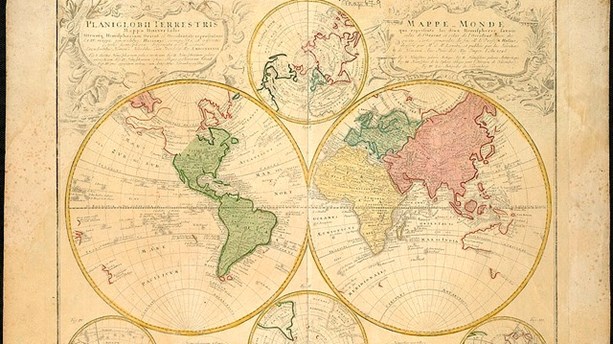
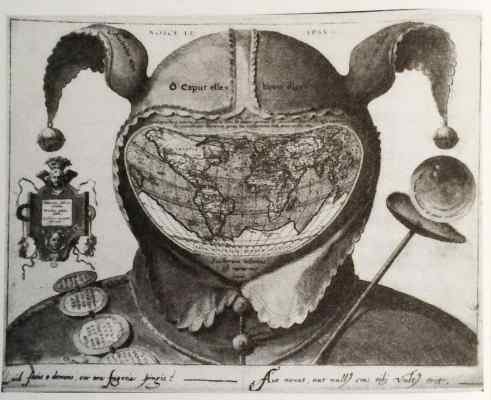
Mappa Mundi

mappemundi

The key question is not what a given sentence means but what it does, especially how it does whatever it does…to know is by definition to say that something is something else and be believed when one says it – Gunnar Olsson, Abysmal

Whatever we might say, we see in all that we say. – Sophocles

Only apparently is it a ‘presentation.’ – Martin Heidegger

It follows that in the world of humans any mark is better than no mark, for without categorization there is nothing at all, not even nothing at all. – Olsson, Abysmal

How small life is here / and how big nothingness.  – Robert Walser, Oppressive Light

Addenda of sorts

Gunnar Olsson

“…in the universe of the sign there are no clear-cut identities, only delayed differences.  Never a dead end, always an already-but-not-yet; never a genuine original, always an imperfect copy.  Language is a simulacrum of simulacra, the privileged hiding-place of the psychoanalyst’s repressed supplement.

“Pushed to its own limits, the difference between identity and difference is that in the world of the former everything sticks to itself, while in the heaven of the latter everything escapes from itself.  Comparison rests on a foundation of difference, for once a sign is interpreted it no longer is what it used to be.  And exactly therein lies the crux of the matter, for it is well established that the structure of language itself makes perfect translation impossible.  It follows that reality is never what it is said to be, for reality and language are never one and the same, a painful lesson

“The conclusion is straightforward: although word and object are always related, they are never identical.” – Gunnar Olsson, Abysmal

Abysmal

A philosophical problem has the form: “I don’t know my way about.”

– Ludwig Wittgenstein –

“The silent spaces between words often speak louder than the words themselves”

-Gunnar Olsson – 

Report: Beginning from the Endless End: A Community of Thinking: The Experience of the European Graduate School

Apply Now: Begin your MA/PhD this Summer 2016 in Saas-Fee, Switzerland

Report: Beginning from the Endless End: A Community of Thinking: The Experience of the European Graduate School

“the center of thought is that which does not let itself be thought”

– Maurice Blanchot

Perhaps a community. 

A community “risking a fragile resilience” (Philip Beesley).

“Distinguishing the indistinguishable.”  “Compatible Incompatibilities.”  “The Origin is Empty.”  “The path to truth is truth itself.”  “More than 1, less than 2.”  We are always with without. 

I feel rich, calm, a sense of belonging.  And loss.  In my second year of a PhD program at the European Graduate School, nestled far and away in the Swiss Alps, in the canton of Saas-Fee.  It is June, it is chilly, high, quiet, separate.  Far from the searing plains of Kansas.  Far from my employment, my partner, my children.  Far from domestic duties and sustaining (endless) chores.  Removed, set apart, drawn up to the mountains, the rivers, the snow.  Another language, an other culture, a situation of difference.

Mladen Dolar, following many great others, tells us we must “slow our temporality.”  That we can “only do philosophy if we pretend to have all the time in the world.”  How could this be done within the everyday?

It feels monastic almost.  30-40 humans from all over the world gathered to hear, speak, inquire and reflect.  Many silences.  All impassioned by the above – the difficult work, accidental work, error-filled work of “distinguishing the indistinguishable” finding “compatible incompatibilities,” facing the “empty origins,” and setting onto the path that has no end, in the risk of a “bad infinity” – of selecting or creating or imagining impossible tasks and eternally postponing them, finding no conclusions, resolutions, foundations – everything put into question, everything problematized, intervened – “the truth is mediation, a passage.”  The happening, the process, of thinking.  So we believe.  And so we gather.  With eminent leaders, guides, mentors (for example, this session: Slavoj Zizek, Helene Cixous, Philip Beesley, Christopher Fynsk, Mladen Dolar, Jean-Luc Nancy, Keller Easterling, Chris Kraus, Alenka Zupancic, Benjamin Bratton, Werner Hamacher, Anne Carson…and more…).  We hear from them, we question, we think with them, think FOR other thought drawn toward us (Hegel, Aristotle, Plato, Heidegger, Foucault, Lacan, Freud, Deleuze, Blanchot, Spinoza, Holderlin, Goya, Beckett, and on…).  What lives, what continues in our seemingly endless end.  What might in-form and unsettle us, what might disturb and enliven us, how we might change-in-relation, again and again and again…

To “take all the time in the world” for 30 days.  To read closely.  To be overwhelmed.  To exhaust.  To end again and again, to fail in hopes to fail better.  To “start in a bad way, in order to arrive in the good.”  The process and problems.  Our “selves” in becoming, the one and the two and the many – always with lack.  Negativity, absence.  “Nothing is identical to itself.”  The “greatest order and disorder exist as one.”  “Constancy is slipperiness and change.”  How do we dwell there and evince.  How do we act to find out?  There is always the other, another, a lack that we seek.  That is nothing, just lack.  Drives and desires and neuroses.  The community of thinkers.

Some of us question “what is wrong with us?”  Why a surplus enjoyment of troubling existence?  Why identities founded on nothing?  “Philosophy always arrives too late” (Hegel).  We can only begin at the ends.  Against nothing.  Yet toward.  And it is here I feel valued.  Here recognized.  Here is a home.  I belong.  In a timelessness of knowing in time.  An everywhere of nobodies anywhere.  Senses replete with mountains and rain.  Clear air and short breaths.  An absence of tasks.  Singular tasks.  Monumental tasks (for me).  That need all of the time in the world.  Are all of the time of the “world”.  Senseless letters.  Turbulent being.  In media res – in the middle of things – when outside already inside, inside where something’s always left out.

My collegiate journals from decades ago are riddled in their margins with: “to be the writer of loss,” “to be the philosopher of grey,” “to compose absence.”  A longing for empty origins since thinking began.  Repetition.

I walk for the body to process.  I dream of sharp thorns in my feet, of lost items, of absence and language and two shades of grey.  Rain comes through the clouds in the fog.  “The end is in the beginning, and yet you go on,” “My mistakes are my life,” – Samuel Beckett.  And so, and yet, I go on.  Intensively, demandingly, having “nothing to write, having no means to write it, and being forced by an extreme necessity to keep writing.” – Maurice Blanchot.

I miss those I hold nearest.  And I love them – how indecipherable the term – further description annuls it.  To say the unsaid or unsayable.  I am confused and elated.  Inspired and exhausted.  Drawn forward through despair.  And I love this experiencing.  It belongs.

“If nothing were substituted for everything, it would still be too much and too little.”
― Maurice BlanchotThe Writing of the Disaster


On Being Other

On Being Other

(after Heidegger, on Holderlin)


Broken off from origin: gods, family, homeland.

Early switched direction – turning back, against, since.

No belonging.  No church, no community of mortals.

Reliant on the peaks and the abyssal.

No lasting love, but efforts toward convention –

when giving up –

even offspring, domesticity,

varietous employment,

almost friends.

No lasting commerce, always in-between,

feeling resistance and restraint,

constraints of discipline and need,

of longings, love, and lust.

Searching Other

fueled by others – across the times –

creators of the peaks and their abysses.

Oscillation.

Not yet rational, it commences –

undone in the unknowing, uncertain constant flow

generates turbulence toward an opening

or a gap, some kind of fold –

“run up hard against the unsayable.”

the closing line is a quotation from Heidegger’s

lectures on Holderlin’s poems “Germania” & “The Rhine”

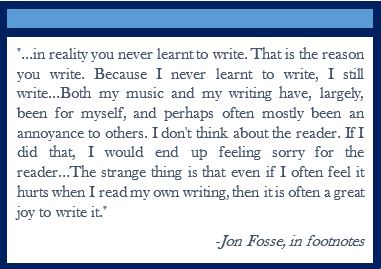
Learning to Write

Fosse QuoteFosse_Angel

A Far Story – Samuel Beckett

I wait for me afar for my story to begin, to end, and again this voice cannot be mine.  That’s where I’d go, if I could go, that’s who I’d be, if I could be.

– Samuel Beckett

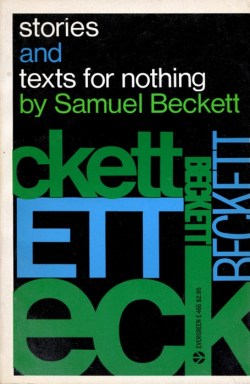
Beckett - Stories Texts Nothing

Nos. 3 & 4, Texts for Nothing by Samuel Beckett

it doesn’t get better than this…unless it’s more of beckett