Let Me Get This Out of Your Way

Intriguing stumble-upon.  Clearing an old flash drive for my daughter I ran across this – texts from my first and only public reading – featuring art by George Ferrandi and Laura Barbuto, which occurred in an interactive reading space with many assistants and much assistance a couple years ago.  Seemed like it belonged in this space.

space_ferrandi

  1. Sitting at table amid a narrative hum. No one speaks.

“Getting it Out of the Way: A Response”

(texts by Nathan Filbert; art/images Laura Barbuto/George Ferrandi)


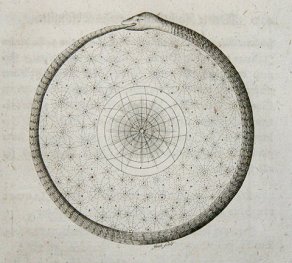
Alias Ouroboros; or, Alias and [the Philosophy of] the Process of Elimination

tumblr_lt17abrdkf1qmdrwbo1_500

Looks, stares, gazes.  Alias, alone (with ants).  In bathroom.  Facing mirror.

Is reminded (from whence and where?) “My way of not being the same is, by definition, the most singular part of what I am.”  Remembers Foucault wrote that (how? why?).

Contemplates.  Scrutinizes.  Reflects.  Adorno: “To make things of which we do not know what they are.”  Wherefore?  Examines his old face for repetition.  For resemblance.

What ever did he suppose the “self” was?  Leans closer.  12 years old, exploring raggedy woods surround childhood farm in the Kansas countryside with a crooked clumsy stick (a settler’s gun).  Who did he posit “others” to be?

Laramie, somewhere far.  Laramie: OFF.  Sister.  Sometime “friends.”  Lucy (before that H____, before that T_____, and prior A______, D_______, J_____, and so on).  Had he come to approximate “himself” at all?  And who and what and where determined that?  Where is the Observer?

What constitutes the subject in its relations to the true, to rules, to itself?” (Foucault had queried) – the “I” in a sentence – and why had he ever read that stuff?  Why did he feel himself “drawn” to it?  Magnetized to self-reflection, chaotic perspective gyroscope?

Can almost see the swallowing snake.  How long he’s longed (like Laramie) to shed obligations and self-evolving charges (children, lovers, homes and labor)…and how lonely alone turns out to be.

Leans back.  The hair, the shoulders, the wrinkles and beard.  Sheer size alone an entirely variant specimen from 12, shape of 20, motility of 3, vim of 47.

But the naming remains: Harlequin – spanning centuries, derived from ancestor’s medieval roles.  “Ignatius” and “Evgeny” – monikers pilfered from grandfathers – representing both (or some) genetic “sides” – the mother’s and the father’s.  Then Alias, alas – selected purely for sound and almost a joke – “let him make his own name” his dad was supposed to have said – “make a name for himself.”  Alias i. e. Harlequin – an identity of shifters.  Contentless, versatile signs.  This or that, also known as, patchwork jester.  Volatile collage.

Multi-colored robes of Joseph – Alias certain he’s never led anything out of bondage – let alone himself.  A joker then?  Entertainer with a deathly fear to perform.  Chameleon, hodgepodge, bum.  Rag-tag coddle of experiences, interests and events: people, places, actions and things.  Jumbled potpourri of knowledge sans expertise.  “Who is this what that I am?” he thinks, unattended, gaping at the bathroom mirror.  “How?”

Sways toward.  Yellowed teeth, crudded sockets.  Webs stringing out from the eyes indexing smiles – from when?

Drinks.  Diarrhea.  Trembles.

Considers process of elimination.  Engages, ingests, transforms…and turns it all to shit.

Precisely!  If we could do without metaphor!  “The real,” “the rules,” “itself” and “other” hacked, torn and blundered, mulched and mushed, pulped and extracted…some to nourish, some to harm, random keeps and passes…What if “itself” were able to masticate, dissolve and disperse, digest and diarrhea itself?  If thinking passed like food and water?

Crush the judgments, statements, words and perceptions. Struggle to swallow.  Swill the pains and fears – chug through the gullet – expel from the sex.  Crap the hopes, the dreams.  Piss prejudice and myth.  Ingurgitate logical systems, impressions and lust.  Eliminate ruin and waste like a transitioning, dynamic…eroding, decrepit, diminishing body.

Examines physique – misshapen shapeshifting slush.  Deliberates learning.  Vocations.  Training.  Behaviors and “talents.”  Successes.

Swallows again, more of a choking or gulp.  Peers closer.  Slurps and gobbles, wriggling it down – acids and micro-solutions…expel, eject, devour.  Autosarcophagy, necrotizing fasciitis, auto-immune (how did he know these things?) parasiting himself – is it possible to empty?  To void?  And where’s Laramie?  Lucy?  The children?

The trots again.  He starts to gag.

Alias and the Ants

trailofants

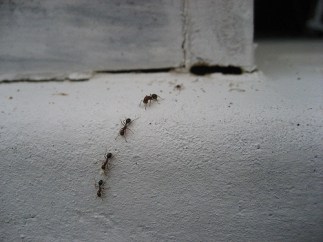
Alias observes the ants in his bathroom.  Each Spring.  Spring or Fall, no matter his warfare – treating / trimming / grooming the perimeter of ‘his’ home – no difference (or differance) – Spring and Fall, a trail, a train, a miniscule “army” (whether ‘Army Ants’ or no, he could not say) of tiny insects crossing his counter from sink rim to (nonexistent) god-knows-where and back again, doing god-and-perhaps-scientist knows what…traversing, infesting, conquering, appearing, occurring…

…Alias is unattended…

Observing ‘his’ (not-his) ants.  A collective of interminable insects roving to and fro between a Lilliputian crack along the paint of his lavatory wall (an outside boundary of ‘his’ ‘home’), the cylindrical rim involving ‘his’ ‘vanity’ (does he still possess any of that?) sink, his children’s toothbrushes (the “family” so wishes the infestation undone) and wherever they might journey over the surface’s edge, the drainage holes, the drawers…

Ants.

Alias composes both paste and powder of Boric acid and particled sugar.  A supposed deadly mix for puny pests.  Like “life” for him.  Murderous moments of sweetness colluded with deathly compounds: vodka, cigarettes, illicit sex; bacon, buttery-fried flour, altitude…

Responsibility (instinct) and desire (impulse).

Alias is alone.  Most definitely that.  Solo and (interpretively) forsaken.

His ‘kids’ are grown.  His loves (clearly) outworn.  His ‘friendships’ recursive, reductive, assumptive, routine.  But the weed-trees, the weather and wear, the spiders, the crickets, termites, and dust…and ants, carry on in a differently (and differantly) incessant way.

Indefatigable.  Undefeatable.  (Like death.)

That within succulent sweetness, luscious limnings of love, lie poisons and trace, exposures – never a joy without risk, no ecstasy lacking its peril, no thriving without its decease.  Positives all laced with negatives, happiness balanced in depress.

Alias gazes.  He stares.  Isolated, trimming at an untrimmed beard over a sink he did not install, looking (and failing to see at all) into a mirror replicating demise…above a trail of ants he’s fed sugary poison for weeks, which appear to be active and thriving, in differance to his own ‘self’ – choking and chortling on pleasures that keep resulting in pains, experiments emerging as monstrous, efforts destroying their ends.

He sighs, does Alias.  However he seeks a team and a trail it leads him to toxin, bane eroding his chance.  Considers Laramie, Lucy (his wife), and each child.  Ruminates purpose or promise or hope.  Wonders how relief repulses its reasons.  Why remedy acts against cure.  How ants insist on their patterns.  Why exultation evinces in ruin.


Alas, Alias

kitty-litter

“Cat litter,” the last thing said, and something about that abandoned bicycle, a child’s bike, deep red, repainted, left askew on their lawn for days.

Those were the last things.  The last things she said.  And so he’d begun to move about much more carefully.  Timidly some might say, an amalgam of caution and care.  Ever tender, aware that things break, or tear, spill, or fall apart.  End.

But then Laramie, his sister, mother, the kids – some entities seem to persist, so few and so stubborn, inexplicably, threatening almost, as if an accumulating disaster, an heavier withdrawal.  He doesn’t know what to make of it.

Abandonment crushes all scales and statistics – but pebbles and dust, foundations and roots still remain.  Persistent.  Resilient.  Irrational.

Like a sloth he repaired to his desk, as delicate and slow.  He took up a pen with his head in his hand.  He was lonely, alone but for quiet, sweet silence, and branches and birdsong and wind, autos and dogs.  Not quite quiet.  Not quite alone.  But abandoned, far as he could surmise.

He wrote.  Rather drew.  Looping lines that were shaky on paper.  Tried to make his operation more smooth.  It failed.  He shakes now, does Alias, from drinking and smoking, aging and grief.  From perspective.  His perspective.

A rattling undone, an erosion.  He sighs.

A bike, and “cat litter,” then gone.  Others had left for much more and much less.  Litanies of reasons of wrongs are so easy with humans involved, never mind the ‘weight of the good.’  Can’t compete.  Won’t compute. There are mistakes, and effort involved – both are failures, no matter the theories or talk, no matter their universality.  He was wrong and a failure, which equals abandon no matter the words they produced.

Alas, Alias.  A depression.  An outlook that colors the field, but it’s charcoal.  No matter the ‘whom’ it will bleed, run them dry, and disfigure.  No one’s withstood it for long, for all of his kindness and passion (devised to distract from the swallowing dark, or the primer – his base coat is death).  He’s alone.

Not a Laramie, mother, or kin.  Without doubt there’s no lover, no friend.  Just a man and his books and incessant grey thoughts, and a pen.

He begins, looping lines…forming “Cat litter,” the last thing she said…

Bike

Character Sketches

Just stumbled upon this one…after 4 or more years!  Thought I’d share, it made me smile:

Dennis Janet and Marianne

Meta-Recursion: Some thoughts on the task of writing

cropped-fish.png

Life becomes ideas, and ideas come to life

Maurice Merleau-Ponty

Metacognition is a buzzword these days – as contemporary sciences dive in to the neuro, neuron, chemistry and activity of bodily systems, we get to “see” our activities and “think” about them in different possible ways.  Our sciences concoct novel theories and processes, instruments and concepts and categories with regularity, and then our cultures absorb and incorporate these beliefs into our self-understanding and relating.  Metacognition “the awareness or understanding [ha!] of one’s own thought processes” is just such a theory – one writers have long thought about and acted as if, never without problematics.

Recursion, or, “the repeated application of a recursive procedure or definition,” is another one – looped and locked in repetitive activities in which our procedures and language “relate to or involve a program or routine of which a part requires the application of the whole, so that its explicit interpretation requires in general many successive executions,” each successive stage affected by the previous and effecting the following, the inside / the outside, the near / the far, the experienced & imaginary, the art / the life.  Endless recursion within a reigning myth of metacognition…and I am writing.

A writer knowing that I’m (a shifting pronoun) writing so also knowing that I’m writing about knowing that I’m writing (yet uncertain or finitely unable to ascertain all that entails) while I’m writing and therefore writing about that as well as what I’m writing, and so on…pertains to language, truthfulness, reason, perception, behavior and any other human activity…complex and recursive in a culture professing metacognition as a possibility.

This complicates writing in tremendous ways.  It becomes very difficult when composing letters and spaces to evaluate anything as “impossible.”

Quantum sciences, computer technologies, object-oriented ontologies and anthropocenes – complexity, indeterminateness, and relativity all serve as a soup in which we simmer, constraining and affording us opportunities that usher us right up to the edges of our finitude.  The interconnections (internet) of things (or not!) reminds us we cannot understand or know enough to write knowledgeably about even our own organisms, and also expose us billions of encounters and experiences per day that recursively become within our systems.  I spread wider and decenter as the membranes that compose me increasingly appear as sieves.

The larger and smaller scales of life may not be operating like our daily experience, yet we often refer to our lives as “daily rounds.”  Relativity and indeterminateness and reversals of such equations, undo previous comprehensions of the filters of space and time, even as the Western ‘historical’ sense of narrativity and order comes undone, tangling in its possible untangling as potentially ‘solved’ in multiple directions at once…leaving us directionless and indeterminate per any ‘correspondence to reality or ‘truth.’”  Selah.

We must have experienced by now toggling between subject and object in any situation, and to whatever degrees our systems are genetically alike they are multitudinously variant as well.  We are currently aware that our perceptive calculations of our contexts are hypothetical or apply in very limited specificities…i.e., ONCE.  So our taxonomies flux, our histories alter, our cognition and perception get meta-statized, and language becomes a wobbling sign in Big Weather.  Waves and warps, folds and possible interjections.

Apparently it might all be in-formation, movements accessible through relation for operationalizing.

Our “subject matter” dissolves since we no longer have a subject acting through a predicate, but all matter interacting in theorized randomness and happenstance with nary a drive to avoid extinction.  Hosts of events (plot?) with endless extrapolations or interpretations, wherein things long distant and disparately far might “fold in” or “warp past” or correlate via some vibration – and perhaps they do? (memory as a pass of ‘reversal’ in subjective time?)

I am writing.  And so all this must be written, in our stories and imaginary objects, holding nothing, requiring application of the whole and very many successive executions.  Sounds ominous, but the terminus thusfar we can still count on.  It will end (for us, as we experience it).  It must be written – increasingly aware of all I do not / most likely cannot know or understand, and that nothing experienced “fits together” while belonging together in ways we haven’t been able to imagine, fragments fed by fragments feeding fragments inseparably fluid…and I write, I try to write it, in channels of existent vocabularies and beliefs inaccurately scoped.

I (whatever that means) seem to be writing with an awareness that I-am-more-not-I-than-I or I is tenuously distinguishable or occasional, and am writing that I am writing while I am writing that I am thinking about writing which thinking is happening through various media like paper and pen and keyboard and digital text and electricity and air and an incalculable and miniscule trajectory of experience waving particles undone and mutated, I adapt, to no purpose (it is theorized) and go on or along and keep writing unaware even of what I am aware of and operationalize a tiny selection of language flooded with other usages and contexts and I write we write it writes as its writing.

“it is through my writing that I keep a hold on life” – Franz Kafka

And, holding nothing, I am unable to stop.

You must go on.  I can’t go on.  I’ll go on.

Samuel Beckett

Parataxis / Parallaxis

parataxis, n.

The placing of propositions or clauses one after another, without indicating by connecting words the relation (of coordination or subordination) between them, as in Tell me, how are you?.

“PARATAXIS, N.” OED ONLINE. OXFORD UNIVERSITY PRESS, DECEMBER 2015.

Parataxis is a literary technique, in writing or speaking, that favors short, simple sentences, with the use of coordinating rather than subordinating conjunctions (from Greek for ‘act of placing side by side’; from para, ‘beside’ and tassein, ‘to arrange’; contrasted to syntaxis or hypotaxis).

It is also used to describe a technique in poetry in which two images or fragments, usually starkly dissimilar images or fragments, are juxtaposed without a clear connection. Readers are then left to make their own connections implied by the paratactic syntax.

WIKIPEDIA CONTRIBUTORS. “PARATAXIS.” WIKIPEDIA, THE FREE ENCYCLOPEDIA

parallaxis, n.

Difference or change in the apparent position or direction of an object as seen from two different points; (Astron.) such a difference or change in the position of a celestial object as seen from different points on the earth’s surface or from opposite points in the earth’s orbit around the sun. Also: (half of) the angular amount of such a difference or change; (Astron.) the angle subtended at a celestial object by the radius of the earth’s orbit, giving a measure of its distance from the earth; any of various similar measures of distance calculated by methods incorporating the motion of the sun relative to the local region of the galaxy, the proper motion of the observed body, the motions of a cluster of bodies having similar distances and speeds, etc.

“parallax, n.” OED Online. Oxford University Press, December 2015. Web. 7 March 2016.


Parallax is a displacement or difference in the apparent position of an object viewed along two different lines of sight, and is measured by the angle or semi-angle of inclination between those two lines. The term is derived from the Greek word παράλλαξις (parallaxis), meaning “alteration”.  A parallax is the difference in the angular position of two stationary points relative to each other from different viewing positions.

Wikipedia contributors. “Parallax.” Wikipedia, The Free Encyclopedia. Wikipedia, The Free Encyclopedia, 28 Feb. 2016. Web. 7 Mar. 2016.

Homo Scribus Attonbitus

a text from the archives…ready again, relevant, near…

hand eye heart

Homo Scribus Attonbitus 

(2012?)

Laramie begs “OFF,” or, what happens is parting

What happens is parting…

The incommensurable does not lie outside of language.  It is language.

– Werner Hamacher, Minima Philologica –

“Off” bothered Alias.  It aggravates Alias that Laramie only and simply, states and declares the term “off.”

Strikes him as unfair.  Short-shrift.   Foregone.  An easy conclusion.  A self-imposed or autocratic EXIT.  Cheap escape.

Conversation (that day) silenced (muted) and dulled.  It soured.  When participants elect not to speak their minds or piece, peace or conflict, new tensions are introduced.  Silence [chosen, selected, fought for (or against), willed] intentional silence effects scenarios like speech.  Withdrawal.

Alias tells him; ‘Refusal to speak equals a sort of speaking.  We are both ‘in it.’”

“Off.” Laramie repeated, simply, only, just “off.”  And, “the switch can be binary, non-complex, Alias, simply a choice – ‘I love you,’ ‘thank you,’ ‘I would prefer not to,’ – ‘no,’ – OFF – please allow me that.  I am tired.  You are my friend.  All is well.  It is good.  Life is hard.  Love is pain…OFF.”

The large, long, horizony cosmic swath of atmosphere containing and surrounding human interaction (in this case, in any case) snaps.  It fractures.  The environment (in this case, with the pronunciation of ‘OFF’) simply breaks.

There is quiet (as in) silent (as in) absence of sound, stillness of action, stasis of communion, of commerce, connection –

VACUUM.  REFUSAL.  A plea and a begging to STOP.  QUIT.  CEASE.  To not continue, to NOT go on.  A demanding request for an end.

Laramie states, speaks, invokes, complains, retorts, confesses, professes, declares and pleads and laments, quite simply, to his dearest, nearest and closest confidante, companion, friend and interlocutor – “OFF.”

Laramie chooses.

Alias wants to honor…

grieves, requests, rescinds,

carries on…

evoking ambiguity, anonymity, fiction and untruth.

The calf.

The finch and bluejay and weasel.

Deer, cow, pasture, thistle.

Friends and morning-glories.

The sun, the air; clouds and mid-day.

Company.

Revoked.


Alias Harlequin – Identities

Picasso_Harlequin sketch

“To recognize yourself in… To multiply your likenesses”

-Edmond Jabes

And what do you suppose it is to be a “Nathan Wayne Filbert” human?  To be named?  Alias Harlequin?

What do you suppose it might be like to be “Ida Sophia Lind Filbert”?  “Jada Lynette Smith”?  “Oliver Myshkin”?

“Hallie Noel Linnebur”?

“Tristan Rene Wells Filbert”?  “Simon H. Lilly”?  “Aidan Stafford”?  “Herman Melville”?  “Paul Feyerabend”?  “Rachel S. Como”?  “Paul O’Callahan”?  “Meghan Miller”?  “Jim H. Charles?”  “Warren Charles Farha”?  “Amanda Marie Lind”?  “Fernando Pessoa”?

A cow.  A particular cow – an Hereford – on a particular plot of land in Mitchell County, Kansas?

“Plato”?  “Kathy Downes”?  “Ortho Stice”?  A Welsh Corgi “Tippy”?  “Napoleon Bonaparte”?  “Charles S. Peirce”?  The clerk at the grocery store?  “Christopher Fynsk”?  That Forest Ranger?  A pet hamster “Jacques”?  “Claudius”? 

WHY SHOULD ANY ONE HUMAN BE ANY MORE INTERESTING THAN ANOTHER?

WHY SHOULD ANY ONE ORGANISM BE ANY MORE INTERESTING THAN ANOTHER?

What means: “EFFECT”?

“William Shakespeare”?  “Avital Ronell”?  “God”?  “John Wayne Gacy”?  “Helena Bonham Carter”?  “Microsoft”?  A caterpillar (be specific)?  “Mahatma Ghandi”?  A sparrow?  Molecules composing particular dust?

WHAT IS?

how are we able to ask that question?

WHAT ARE WE?

how might we be “WHOs”?

Starting local:

What might it be like – as a “Nathan Wayne Filbert” (Nobody) – to BE a “Nathan Wayne Filbert” (A body)?

I’m not sure HOW to answer that.

“Perhaps writing means overcoming all resemblances within the very heart

of resemblance, being finally like yourself, like nothing.”

  • Edmond Jabes –

i.e. How that can be answered.

– WHO or WHAT answers – ?

WHAT MIGHT IT BE LIKE…TO BE?

(qualified to ANSWER)

can ANYthing “answer”?

does “answering” imply “language”?

WHAT IS AN ANSWER?

(in relation to – ?)

What is(?) Nathan Wayne Filbert, Alias Harlequin?

IS “Nathan Wayne Filbert”?

WHAT IS?

WHAT IS IS?

(how?)

WHAT IS A QUESTION? And WHY/HOW can a question be asked?

WHAT IS IT – are our – ideas?  – To “IMAGINE”?

what are ideas?

What might it be to “conceive”?

“to generate concepts” (D&G)

framings of our world-experience

[WHY?  HOW?

WHAT FOR?]

WHAT is a “person”?  HOW?  WHY?  WHO?

Always and ever – HOW & WHY can we / do we ASK?

WHO QUESTIONS?

(WHAT)?

(HOW)?

Something begins

                                          (in/with all this)

                                                                                          it would seem

(it seems)

it seems that something begins in/with questioning

Alias Harlequin, i.e.

– the one whom this effects, the one on whom this has effect, the one (same? No!) affected by him or her, by whom and it.  By this.  This.  That.  By Other, others, and therefore, Alias again, patchworked and quilted, becoming, undoing, altering.  Alias.

“Presumably most writers have many more ideas than they are able to act on”

– Ivan Vladislovic, The Loss Library

Alias Harlequin – identities – is as is affected, effects, effected with/by.

Alias, i.e. as effected by “Hallie Noel Linnebur”; as effected (generated?  Co-composed-with-) “Pauline Margaret Kresin Filbert”; the St Bernard “Zorro”; a specific train on a particular journey at a particular time; that mountain in that moment; Dec. 16, 1997 – a flu; and so on…

Alias – as situated in moments – e.g. “each one.”  Harlequin – the human surname quilted with environment (micro-to-macro) in concourse.  “Alias” as the “name in shreds” – the fragmentary and provisional, pragmatically specifiable address.

Ambiguous and fluid (like “river” itself – capable of designation but inconsistently contained) transient yet locatable, in form…perhaps.  Yet no.  “Alias” perhaps the medium (in-between) of morphing form and varying substance – what nothing also is (is not).

Name/term/signal/sign (“Alias”) as related to HNL, Dr. K, Dostoevsky, rustled grass, these sounds, this space-time and its company (surround) and then again, these again (but never “again”) – designating “NOWs”.  Perhaps.  It depends.

What or Who, How “Alias Harlequin” ALWAYS depends on a totality of other dependencies, as it were (or is?)  “As such.”

Alias Harlequin, representative?  Not that can of worms.  AND the “thing” itself? (network of momentary dependencies-in-relation)?

What might we call (it/him/etc.) then?  And what would “calling” be/do – how?

WHO questions?

This Alias Harlequin.

“I am already so much the inscription of a divergence…What I was, if that could be described, was a whirlwind of tensions…”

Helene Cixous

“A word is binding and at the same time breaks our bonds.
To which of them shall I, one day, owe my freedom?”

“To one only.  Your name in shreds.”

-Edmond Jabes, Book of Resemblances