Ouroboros, or Autophagia

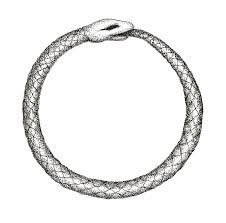
Ouroboros

I often feel that I’m dying.  Killing myself with disease. Killing myself via the activities of my “mind.”  Killing myself with alcohol.  Killing myself by over-extension, -exertion, lack of self-regard.    Worry.  Anxiety.  Perfectionism.  Wishes.  Desires.  Dying from the absence of sex (and yet orgasm is also a breathless ‘little death’).  Dying from lack of joy.  Dying of disuse, depletion, or disregard.  Dying of my own engulfing life.

Which only emphasizes the insistent FACT.  One thing we know, perhaps the ONLY certainty we’ve understood in the thousands or millions or billions of years we’ve been species-al (spec-ial) and aware of such information…is that we are dying.  Constantly.  Continuously.  Unstoppably.  Irrefutably and inescapably.  Inevitably.

Whether we do it to ourselves – amplify or expedite its course – or are at the mercies and whims of some enormous cosmic complex entanglement; whether our cells turn against “us,” or we turn our “selves” against our cells; excruciating or peaceful, ecstatic or terrifying – WE DIE.  ARE DYING.  WILL DIE.

For some, this undeniable evidence and unstoppable knowledge instigates a kind of “dead-already” worldview or perspective…a nihilism for some.  A not-ness.  A foregoing of LIVING, a preemptive attack, or some strange passion of alignment with the TRUTH – some subversion of the FACT (at the same time true, and as certain) – that a DYING thing MUST be LIVING.

An “it doesn’t matter.”  Usually tacked on with an “ultimately.”  Meaninglessness.  Pointlessness.  Purposelessness.  Something some supposed “scientist” (devoted to “objective” observable “truths”) like a psychologist, biologist or physicist; doctor or therapist or mathematician – might call “depression,” “skepticism,” “cynicism,” – when in FACT it is adherence to one of the ONLY FACTs we’ve described or descried that has held TRUE while all of our tools, technologies, expansions of knowledges and theories, inventions, medicines and so on carry on their wars against it.  A veritable CERTAINTY (indeed, perhaps the only occurrence in which a human being accords with reality).

DYING.  From there – who knows?  “At one’s own hand/operations” or “at the mercy of” environments, situations, circumstances, world… who knows?  No one.  Uncertainty.  The process of being-alive to being-dead is fraught with everything else we are able to imagine.  And almost entirely UNCERTAIN.

It happens.  Living.  Then Dead.  Each one.  Every one.  “Me,” “You,” “I’s,” “They’s,” “We’s,” “Those” and “These.”  Whatever begins…ends (in some form).  Whatever emerges, converges and devolves.  Whatever occurs…deceases.  Ceases “to Be.”

And so what do we do…what do “I” do…with this LIVING?  In full awareness of the synonymity – LIVING/DYING – why is the awareness of dying and depletion of a potency that oft outstrips its necessary , indeed indubitable counterfactual?  LIVING.  LIVING.  LIVING…

Who now, what now, where and for why?
reading dead profile

Not-Belonging, Chapters

I feel somewhat apologetic, but here is one more selection from my archives.  Another that when I re-read I am unable to see how I might do better, or how I ever got it done at all, yet all my work un-published or rejected, so I know it is not “good enough” per whatever the current cultural milieu would prefer.  “No matter.  Try again.  Fail again.  Fail better.”  Perhaps.  In any case, it circles around for me like the tail-eating snake I am, in hopes it might engender something new, no, in hopes it might be put to rest.  For any who read it, I would be hard pressed to metaphor my astonishment, humility, gratitude and begging-of-patience, including a sheer and sharp ache of deep appreciation for your life’s time and likely unwarranted, gracious, attention.

does-not-belong-worksheet-worksheet

Chapters That Don’t Belong

(please click image or title for text)

many thanks

Meta-Recursion: Some thoughts on the task of writing

cropped-fish.png

Life becomes ideas, and ideas come to life

Maurice Merleau-Ponty

Metacognition is a buzzword these days – as contemporary sciences dive in to the neuro, neuron, chemistry and activity of bodily systems, we get to “see” our activities and “think” about them in different possible ways.  Our sciences concoct novel theories and processes, instruments and concepts and categories with regularity, and then our cultures absorb and incorporate these beliefs into our self-understanding and relating.  Metacognition “the awareness or understanding [ha!] of one’s own thought processes” is just such a theory – one writers have long thought about and acted as if, never without problematics.

Recursion, or, “the repeated application of a recursive procedure or definition,” is another one – looped and locked in repetitive activities in which our procedures and language “relate to or involve a program or routine of which a part requires the application of the whole, so that its explicit interpretation requires in general many successive executions,” each successive stage affected by the previous and effecting the following, the inside / the outside, the near / the far, the experienced & imaginary, the art / the life.  Endless recursion within a reigning myth of metacognition…and I am writing.

A writer knowing that I’m (a shifting pronoun) writing so also knowing that I’m writing about knowing that I’m writing (yet uncertain or finitely unable to ascertain all that entails) while I’m writing and therefore writing about that as well as what I’m writing, and so on…pertains to language, truthfulness, reason, perception, behavior and any other human activity…complex and recursive in a culture professing metacognition as a possibility.

This complicates writing in tremendous ways.  It becomes very difficult when composing letters and spaces to evaluate anything as “impossible.”

Quantum sciences, computer technologies, object-oriented ontologies and anthropocenes – complexity, indeterminateness, and relativity all serve as a soup in which we simmer, constraining and affording us opportunities that usher us right up to the edges of our finitude.  The interconnections (internet) of things (or not!) reminds us we cannot understand or know enough to write knowledgeably about even our own organisms, and also expose us billions of encounters and experiences per day that recursively become within our systems.  I spread wider and decenter as the membranes that compose me increasingly appear as sieves.

The larger and smaller scales of life may not be operating like our daily experience, yet we often refer to our lives as “daily rounds.”  Relativity and indeterminateness and reversals of such equations, undo previous comprehensions of the filters of space and time, even as the Western ‘historical’ sense of narrativity and order comes undone, tangling in its possible untangling as potentially ‘solved’ in multiple directions at once…leaving us directionless and indeterminate per any ‘correspondence to reality or ‘truth.’”  Selah.

We must have experienced by now toggling between subject and object in any situation, and to whatever degrees our systems are genetically alike they are multitudinously variant as well.  We are currently aware that our perceptive calculations of our contexts are hypothetical or apply in very limited specificities…i.e., ONCE.  So our taxonomies flux, our histories alter, our cognition and perception get meta-statized, and language becomes a wobbling sign in Big Weather.  Waves and warps, folds and possible interjections.

Apparently it might all be in-formation, movements accessible through relation for operationalizing.

Our “subject matter” dissolves since we no longer have a subject acting through a predicate, but all matter interacting in theorized randomness and happenstance with nary a drive to avoid extinction.  Hosts of events (plot?) with endless extrapolations or interpretations, wherein things long distant and disparately far might “fold in” or “warp past” or correlate via some vibration – and perhaps they do? (memory as a pass of ‘reversal’ in subjective time?)

I am writing.  And so all this must be written, in our stories and imaginary objects, holding nothing, requiring application of the whole and very many successive executions.  Sounds ominous, but the terminus thusfar we can still count on.  It will end (for us, as we experience it).  It must be written – increasingly aware of all I do not / most likely cannot know or understand, and that nothing experienced “fits together” while belonging together in ways we haven’t been able to imagine, fragments fed by fragments feeding fragments inseparably fluid…and I write, I try to write it, in channels of existent vocabularies and beliefs inaccurately scoped.

I (whatever that means) seem to be writing with an awareness that I-am-more-not-I-than-I or I is tenuously distinguishable or occasional, and am writing that I am writing while I am writing that I am thinking about writing which thinking is happening through various media like paper and pen and keyboard and digital text and electricity and air and an incalculable and miniscule trajectory of experience waving particles undone and mutated, I adapt, to no purpose (it is theorized) and go on or along and keep writing unaware even of what I am aware of and operationalize a tiny selection of language flooded with other usages and contexts and I write we write it writes as its writing.

“it is through my writing that I keep a hold on life” – Franz Kafka

And, holding nothing, I am unable to stop.

You must go on.  I can’t go on.  I’ll go on.

Samuel Beckett

Parataxis / Parallaxis

parataxis, n.

The placing of propositions or clauses one after another, without indicating by connecting words the relation (of coordination or subordination) between them, as in Tell me, how are you?.

“PARATAXIS, N.” OED ONLINE. OXFORD UNIVERSITY PRESS, DECEMBER 2015.

Parataxis is a literary technique, in writing or speaking, that favors short, simple sentences, with the use of coordinating rather than subordinating conjunctions (from Greek for ‘act of placing side by side’; from para, ‘beside’ and tassein, ‘to arrange’; contrasted to syntaxis or hypotaxis).

It is also used to describe a technique in poetry in which two images or fragments, usually starkly dissimilar images or fragments, are juxtaposed without a clear connection. Readers are then left to make their own connections implied by the paratactic syntax.

WIKIPEDIA CONTRIBUTORS. “PARATAXIS.” WIKIPEDIA, THE FREE ENCYCLOPEDIA

parallaxis, n.

Difference or change in the apparent position or direction of an object as seen from two different points; (Astron.) such a difference or change in the position of a celestial object as seen from different points on the earth’s surface or from opposite points in the earth’s orbit around the sun. Also: (half of) the angular amount of such a difference or change; (Astron.) the angle subtended at a celestial object by the radius of the earth’s orbit, giving a measure of its distance from the earth; any of various similar measures of distance calculated by methods incorporating the motion of the sun relative to the local region of the galaxy, the proper motion of the observed body, the motions of a cluster of bodies having similar distances and speeds, etc.

“parallax, n.” OED Online. Oxford University Press, December 2015. Web. 7 March 2016.


Parallax is a displacement or difference in the apparent position of an object viewed along two different lines of sight, and is measured by the angle or semi-angle of inclination between those two lines. The term is derived from the Greek word παράλλαξις (parallaxis), meaning “alteration”.  A parallax is the difference in the angular position of two stationary points relative to each other from different viewing positions.

Wikipedia contributors. “Parallax.” Wikipedia, The Free Encyclopedia. Wikipedia, The Free Encyclopedia, 28 Feb. 2016. Web. 7 Mar. 2016.

On “waking depressed,” or, Human Clear-sightedness

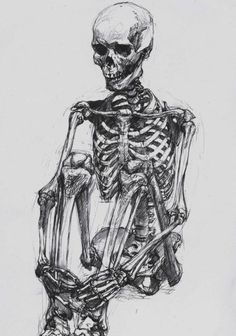
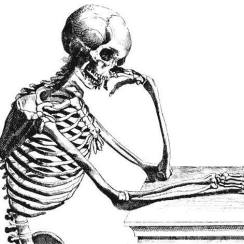
skeleton

We say that we “wake up depressed” wonder why and conjure up reasons.  What is this “hollow” or “indentation” in relation to?  Depression versus delusion?

Squirming up out of dream or slumber into wakefulness, awareness – illusions and solipsism scattered by light of day, by alertness – what would be the “norm” ‘depression’ dips under?

Say we consider “normal” as the state or condition of being aligned with what is.  The only certain trajectory of living is dying.  Dying the condition of life.  The only permanent outcome of breathing, saying, doing, being…are their cessation.  In confirmation or conformation to this “reality” – what should be the normal living response?  Depression, I should say, full awareness and wakeful understanding that my promise, potential, outcome and fortune are to end.

Decay, departure and death are the certain “norms” ruling human existence.  What occurs, forgets; what merges, diverges; what events, unravels; what happens, undoes; what is made, erodes.  Assuredly, they are strange loops, ambiguous and temporal – more wave/particled than 0/1 – and yet as “fate” or “doom” would have it (definite futures) we know of no other.

Therefore it should seem “depression” would be the normal human state of life, and all forms of happiness or joy come about due to some compromise or delusion – an abnormality – some neuroses or failure to accord or conform to what is.  How might we have come to classify conformity to what is as a “disorder” or diagnosable swerve?

“Certifiable depression” is marked as a disability, a failure to thrive, a condition incapacitating function.  Yet does that not most assuredly accord with the certitude of demise, destitution, eradication?  To terminate activity, halt health, conclude creativity, finish folly and destroy delight would all seem to indisputably align with the necessary phenomenon of obliteration.

Thoroughgoing comprehension of what is – that birth has a single objective – that all roads lead to one – that all effort leads to naught – that entropy – is not lunatic, demented, deranged or unhinged – but rather most enlightened and balanced, intelligent and lucid, perspicacious and well-advised.

Being pressed down, a lowering of quality, vigour or amount, feelings of severe despondency and dejection are surely the most accurately normal experiences – regulated, coordinated and adjusted to what is versus what is imagined or desired – indications of astute apprehension and capacities of apperception to the real.

Do not be flummoxed by “waking depressed” – do not seek for treatments or reasonings ‘why’! – do not be baffled that a heaviness descends, or a ‘pressing down’ is felt or occurs – we emerge into life and descend into matter…the cradle and grave a continuous process.

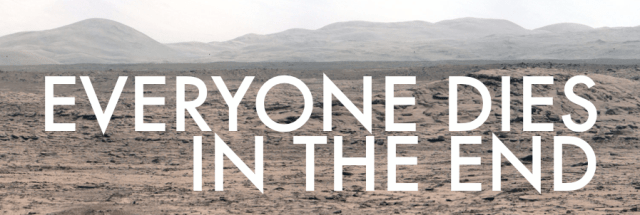
everyone dies

Laramie & Alias

Nobody

Laramie and Alias play ball.  Laramie or Alias.  Alias, Laramie.  What game are we playing?

Riven, desiccated, they lag.  Every day there is more to it.  More and less to them.  Laramie, Alias, friends as long as they can remember, or markers of memory and experience for one another that initiated chronos, now an aeon, now all of what they know.

Laramie falls behind.  Laramie, a little hoarse from laughing, spits out a “hold back!”

“C’mon you little horse,” Alias decries.

What are they playing at?

Long enough that when Laramie commands “Alias Harlequin!,” at this age,  the same mixture of guilt and fear, defensiveness and shame, defiance and harshly judged helplessness Alias feels when seriously called out by parents or lovers shivers his body.  Occupies his mind.  Why?  Why are these things in me, Alias looks down and away.

There is no ball.  It wasn’t a game.  Laramie and Alias walk and wander.  In woods, on paths, through fields.  They try to think together.  Alias has always wondered who he was, or is, or might be.  Laramie never knew, but did it anyway.  Somehow together they were themselves, or felt that way, felt like nothing at all, just present and curious and comforted.  Like learning, Alias thought.  I feel like I’m learning with Laramie.  Always learning something neither of us know.  They talk together.  They call this thinking.  Many refer to it as a game.

Laramie’s butt is on a bench.  He is smoking.  He doesn’t smoke.  His wife doesn’t like it.  His kids don’t like it.  His body, even, has begun to finally recoil.  Alias takes a drink.  Leans against the bench, still guilty, still staring into the trees.  He doesn’t want Laramie to die.  He doesn’t like death much.  It scares him, and it seems simple and true – unavoidable – simply ruinous.

Alias Harlequin sighs.

And Laramie asks what he is thinking.  Or feeling.  Or what is going on, at that moment, for him.

Alias is silent.  How could he know?  If he reaches in, or pays attention to any part – a limb, his gut, the sithering language slithering in what seems like his head – he’ll be inaccurate.  He can only tend to fragments.  Figments of experiencing.  But he doesn’t want the game to be like that.  He’d always hoped someone might know.  Like maybe Laramie knows and is just waiting to see what aspect Alias would select.  Might know something else about Alias’s present that comes from outside of him, that can observe him as a whole, that looks in another direction.

“What do you think?” Alias says.

“Nostalgic,” Laramie reports.  “Some sort of melancholy in lots of places at once.”  “A wend, a bundle, an amorphous pool of forms.”  “This is how it comes and goes at our age,” he breathes.

Nothing.  No response.  Not now.  But it’s an infinite conversation.

Laramie and Alias

Context of Alias Harlequin

Nobody

Theory of Bloom : Tikkun

Tikkun Bloom

To 2016

I am uncertain why I am sharing this, it comes from a personal email response to a friend, but as I was writing it, things that were coming up resonated profoundly in me.  Composition just does this for me.  I suppose I want it on public record for my own remembering.  That I learn things about me, that change is possible, that decay is transformative.  Okay then I am posting a personal reflection for myself – to declare it more widely in lieu of a personal social group.

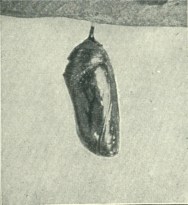
chrysalis

“leaning upon nothing because nothing offers support”

-Maurice Blanchot-

The following is a response to a scholarly conversation regarding philosophy, science, cognition and so on…entirely out of place or sync, but seemed a personal confession on the passage of time and what it reveals…

Greetings —-.  It is good to hear from you.  I’ve been inundated per usual with family activities – good and tiring – and disorienting to my habits of reflection to some extent.  Feeling a bit bewildered re: semester start-up and the madness it brings, and yes, missing ANY considered interaction and dialogue.  I feel lucky to have encountered you.

Wee, random breaks and work-from-home days incite my nostalgia and bodily recall of creating creative work in language.  I ache for it.  Loss of its regularity is a depletion that changes me.  But then I read, “the process of transformation consists almost entirely of decay” from a book about butterflies.  And “we have not much language to appreciate this phase of decay, this withdrawal, this era of ending that must precede beginning” from a commentary on it by Rebecca Solnit, a fine book – A Field Guide to Getting Lost that I like to read while traveling.

I suppose as the library is closed and our work quiet and insect-like on research, curriculum, and admin reports back here…my sociality turns to the work of being open and refusing stress in interacting with my beautiful children.  Which clicks onward into the ever-insistent questioning I face regarding whether there are adult relationships that can be predominately nourishing or reciprocally intimate.  Do we offer one another boon?  Any of us?  Our interactions have consistently done so, and I am very thankful to you for that.  So much conversation wears on me with the subterfuge and maneuvering to get anywhere near meaningful discourse.  I suppose I am tired, and perhaps in a strain of melancholy.  The wishing I could sit back with a drink and listen to intelligent talk without necessity of defense or critical acumen.  Just enjoying that we can.  Imagine and inform one another as humans.  I want this to mean something for me.  To mean I go about things variantly, shy from exhaustion and welcoming to possibilities.  From where does this determination to endure come from?  To “make the most of” idle repartee, body language, archaeology of behaviorisms and attitudes, – supplying too much (or inordinately) in order to learn in situations.  I dream of the luxury of perception and interpretation without analysis.  Reception.  Or where analysis co-creates itself.  Mutuality.  Enjoyment versus labor.  Or an effortless labor to enjoy.  Ahem.  Off-track and losing…

All this, I suppose, to apologize for my lack of acumen in the dear and full emails you and —- have provided…and probably an explanation of my messages of links rather than thought.  Others’ works as hopefully substantial stand-ins for my intellectual lack or confusion.  I do not know where the path is at present.  Just spinning in a lot of literature and activity.  Confession.

Trying to view decay in a hopeful manner.  The slow tears in relationality that introduce distances.  From friends, to partners, to ‘self’ – the flux of it all.  Many seem to have a greater capacity than I for working thematically regardless of internal/external context.  More flexible beings, I suppose, less bound by circumstance and scenario.  Ah well, this is no relevant response to your missals.  Apologies.  They enliven me – simply that thought and invention are going on around me – so please share them all as they arise – it is a great matter of hope for me to watch thought and process in others.  A stay against loneliness.  Thank you.  As I age along, some confusions do seem to dissipate…particularly confusions of my own blindnesses.  What nourishes me: intimacy (emotional, intellectual and physical), the thought and imaginative work of others, people striving to process experience on multiple levels, quiet & rest & reflection.  The commerce of ideas and bodies – entangled minds and bodies – passion and gentleness and reflection.  When these dissipate or decay or are absent in some strange idiosyncratic equilibrium, life is just harder for me to insist on.  And how terribly crucial the activity of writing is for me in my own ability to process my experiencing.  A weird alchemical embodied activity for me that seems to bring forth learning, feeling, imagination and all those characteristics I would like to take root in myself, to be me.  I am better when I write.  Better when I love.  Better when I rest.  Better with meaningful dialogue.  All sounds simple and general, but revealed ever more insistently to me as my epidermis thins.

Another turn of the wheel, bellows to the desire to thrive before the end.

To 2016 then.  And hope.

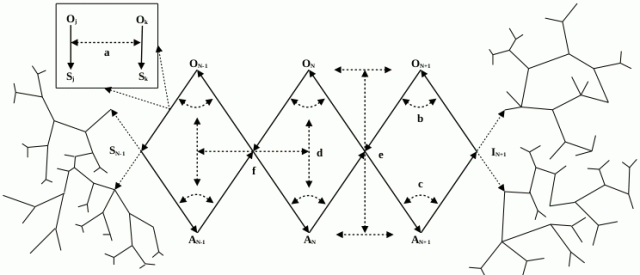
Something better soon.Kockelman_Figure 9, BSTCSG

Begging your patience at year’s end…

Who is Writing

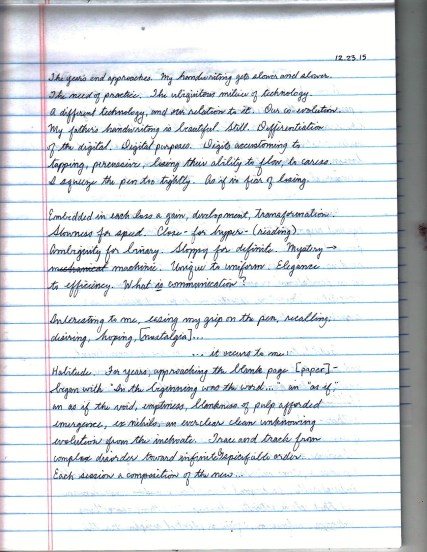
The year’s end approaches.  Writing by hand grows slower.  In need of practice.  The ubiquitous milieu of technology.  A differing technology, and our relation to it.  Our co-evolution with it.  My father’s handwriting is beautiful.  Still.  Differentiation of the digital.  Digital purposes.  Digits accustoming to tapping, percussive, losing their ability to flow, to caress.  I squeeze this pen too tightly.  As if in fear of losing.

Embedded in each loss a gain, development, adaptation, transformation.  Slowness for speed.  Close- for hyper- (reading).  Ambiguity for binary.  Sloppy for distinct.  Mystery – machinic.  Unique for uniform.  Elegance to efficiency.  What is communication?

Interesting to me, easing my grip on the pen, recalling, desiring, hoping, [nostalgia]…

…it occurs to me:

Habitude.  For years, approaching the blank page [paper] – began with “in the beginning was the word…” an “as if,” as if the void, emptiness, blankness of pulped tree afforded emergence, ex nihilo, some everclear clean unknowing evolution out from inchoate.  Trace and track from complex disorder toward infinitely specifiable order.  Each session a composition of the new…

I am struck by the assumption.  Presupposition of potential: that ANYthing might blankly begin (already, like bicycling, shoulder-elbow-wrist-hand and its particular angles operating this ink-stick picking up pace, stretched and loosening, reaching stride).  Presumption of absence, emptiness, a universal glory of “From nothing: This.”  I create.

Happens no more.  Reviewing the increasingly sparse occasions (with age and responsibilities) I am able to operate with technologies of paper, pen and hand-i-writing over the past few years of employment, reading, writing, parenting and relationship…the fundamental (as in foundational, originary) manner of approach…to composition, inception, expectation, hope and desire…is significantly altered.

The fidelity to languaging remains.  That belief, commitment, conviction and trust that ordering the disordered – shaping absence, mattering energy – still transacts secrets into reveals, fabricates meanings of mysteries, is an activity of arbitrary author-ing/-ity; that experiencing’s a processing of signs, of signaling and symbol – that invention, discovery and behavior = complex activities/adaptations of interactive dynamic systems interlocking at multiple scales – inexplicable, indecipherable, far beyond observation or comprehension – and that action or activity actualizes SOMEthing = something unknown, unforeseen, “free” or “new” or potential simply via the inter-, intra- activity of operationalizing with an environment – IN it, part and particle, (that all ‘moments’ eventuate this)…and yet,

There is difference.  Cermonializing, greeting, risking the activity of encountering, engaging, marking a blank page (against death, in hopes of being, realizing desires, imagining, etc.) no longer invokes “In the beginning…” or “word…” somewhere/sometime along the living this transmuted into “Who is writing – ?”

Space-time carved, empty notepad placed, pen inked and ready, and only the sensation, the amorphous geography of a question emanates – Who is writing here now?

No more an assumption that Someone prepares to express, incise, inscribe.  No more presumption that given the space and the time “I” am an entity full of content waiting for production.  No more Someone with Something to process, work out, or to say…

Simply – “Who is this coming to write?”

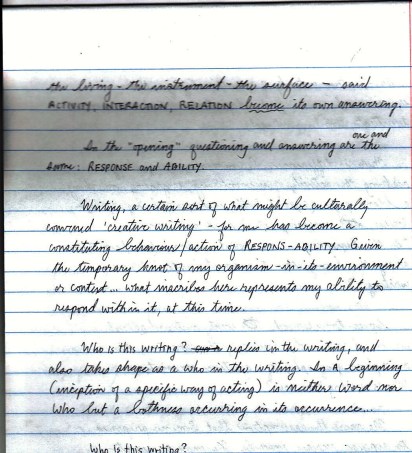
And any word will do.  Any mark.  But not just ANY word (although also that) – whatever word(s) come to occur between the living – the instrument – the surface – and said ACTIVITY, INTERACTION, RELATION becomes its own answering.

In the “opening” – questioning and answering are one and the same: RESPONSE and ABILITY.

Writing, a certain sort of what might be culturally convened ‘creative writing’ – for me has become a constituting behavior/action of RESPONS-ABILITY.  Given the temporary knot of my organism-in-its-environment or context…what inscribes here represents my ability to respond within it, at this time.

Who is this writing? replies in the writing, and also takes shape as a Who in the writing.  In A beginning (inception of a specific way of acting) is neither Word nor Who but a bothness occurring in its occurrence…

Who is this writing?

Who is Writing2.JPG

“When I write I escape myself, I uproot myself, I am a virgin; I leave from within my own house and I don’t return.  The moment I pick up  my pen – magical gesture – I forget all the people I love; an hour later they are not born and I have never known them.  Yet we do return.  But for the duration of the journey we are killers.  (Not only when we write, when we read too.  Writing and reading are not separate, reading is a part of writing.  A real reader is a writer.  A real reader is already on the way to writing.)”

-Helene Cixous-

Meaning

From an email conversation I am involved in regarding human relation to technology…seemed to expose a who-I-am via what-I-concern-myself-with moment in my life worth sharing… and would love any/all comments, ideas, perspectives, regarding:

“I like that inference of thought…influence of larger and smaller systems interacting in our particular (as Lemke refers to them – “focal levels”) living.  I think from Heidegger onward that attention to the reciprocal or interactive influence of what we devise/make and who we are and what makes us continuously reshaping/constructing/constituting us IS a fundamental challenge/question Humanity is within.  This is why I am drawn to technesis as a human activity.  There is no difference from developing domiciles and agriculture, accounting and writing, language and representation in its holistic alteration of the species as there is with what we are within with the devotion to the “digital” – an oddly ubiquitous remediation of experienced matter-ridden-media into this ONE SORT OF ORGANIZATION/CODING.  A strange phenomena.  I think the nearest relative is “writing” and this is where Hansen (“Embodying Technesis”) and Hayles (“How We Think”) as well as Hodder & Ingold’s anthropological works help elicit perspective (& Kittler) on how ALL technological development (craft, architecture, invention, production) so foundationally EDIT us as a species… akin to geophysical change for all forms of biological life.  I suppose what I hope for is some small increase in awareness &/or experiment of capability for Human-kind to discern what amount of agency we may (or may not) have in relation to what we evolve and construct.  Is the system too vast – the biological motive too strong – to continue exploitation and networking (also increasingly representative of our fundamental relationality) – or are we a kind of thing that can affect larger systems in such a way that is transformative?  How small of a part are we, what are our limits of capability, do we have ANY genuine (actual) capacity to discern telos of larger systems… or not (trickles all the way down to personal behavior and ‘psychology’) – can we ever determine our AGENCY (collectively / personally / speci-ally)?  Or is it airy imagination and the activity of abstraction?

Sigh.  This is where I’m at…”