A Possible Paradox for Ida

“To tell the truth” always requires a certain amount of fabrication!  Lying is natural, comes of itself”

-Paul Valery, Monsieur Teste-

Enough is known to know I will not know it.  Know what?, I am able to ask.  What I don’t know.  Enough is known to know that.

That’s leaving aside the forgetting and confusion.  The shaky content of what I barely, and rarely, know (retain or recall) of what supposedly I “know” already.  Ever slipping, fragmenting, recombining, sieving in and out of my “experience.”  All mostly a matter of hearsay, of reading and listening, of the saying-so of others, of instruction, of my own perception and interpretive intrigue.  Nothing known for certain, only “known” in certain ways, at certain times, simply operable and opportunistic, happenstance conflagrations, bastardized convergences.  My “knowledge.”

On occasion, per occasion, one might say I “know” something.  I must “know” to utilize paper and pen, a share in the language to be scribbling these terms, an awareness of others who might recognize them – words and marks to read and write, perhaps to say…

…on occasion.

Per occasion, it sometimes seems to function – these words, these sounds, these marks and referents, inventions – at times, in places… per occasion.

Enough to know there is not much known, and that, occasionally.

In many situations even what is written above would be to no effect.  Unknown or unknowable, misunderstood and mis-taken, discombobulating.

On occasion I have thought that I was coming to know.  A thing or two.  (“When the mind has put a thing through a certain number of transformations, it can only let go of it.  A ‘thing’ is that which can undergo such treatments without becoming unrecognizable.” – Paul Valery).  Some equation, expression, a certain order of words or section of world, apparent communicable system or game, even familiarity with so-signified “facts.”

Enough to know I did not know what I thought I knew.  Per occasion.

Contradiction.  Non-transference.  Con-fusion.  My “knowing” as some idiosyncratic amalgam of language and what is called “experience,” or moving about and within an environment, participant, (of which language constitutes such large part – whether gestures, ideas, dialect, signs or names – yet apparently also extending beyond and outside of language – the ‘unsayable’ – or so it is said – “We can do something to what does not exist: we can name it” – Valery), all of which, when tested by or combined with further, other, subsequent and/or prior language + experience… dissolves into significant doubt and is put into question (experience), per occasion.

In other words, what appears to be “knowledge” is a continuous process of revision, correction, and extension, according to occasions or events.

An example: a “fact” is announced: “2+2=4.”  Ocean & mountains + Nathan & raft = 4.  Ida & Oliver + Dad & home = 4.  A snake & a number + a planet & drought = 4.  A dead horse & winter storm + a beard & a fire = 4.  Each designation unequal.  Two persons, two environments, two numbers, two perspectives, two experiences (and so on…) 4 wildly differing worlds (experiences, occasions).  Any pair of designated elements + any pair of anything else = factually four diverse realities.  Experience and language are uncountable, as every portion abstracted to “count” or “measure” is untrue.  The facts are counterfactual.  It is said that in some realm or practice designations may be calculated as torn from experiences and occasions and language – as abstract systems.  But in what “realms?”  What realms do not arise in messy, fuzzy, occasional experience?  In fact, there are no accounts, records, calculations, or reports – all such verbs and activities necessitating “occasions” and/or “experiencing” – to be.

It tempts me to say “nothing is known” (for certain) but that reads a lot like a statement of knowledge.

Dear daughter of paradoxes: is this a paradox?  “If I have certain knowledge it is the knowledge that I know nothing for certain”?  or, “It is certain that knowledge is uncertain”?

I am not sure.
notes

Why not call it magic, this unsettling alloy of grief and anger we experience when shunted by anxiety, disappointment, depression, or loss?

We cannot deny that we crave!  That we are struck through – bolted with fervent desire (all that which we experience as, well, unsettlingly – disturbingly – vital, ALIVE, active, possessive, in us) – when we are crushed, smushed, squelched, or helpless, hopeless, dismayed – how else could we be?

Without the vital, fierce passions – the damage is to no effect/affect.  Depression must press against something.  Must be pressing something down.

“Am I at the right house?” the internet-technology-installer asked from my gate.

“How can I know?” I responded, “it would depend on the future.”

He checked the numbers and moved away.

Now how will we ever know?

Isn’t this what every human encounter re/presents?

So de-pression presses something down in us.  Anxiety stirs.  Sorrow re-cognizes meanings.  No negative without its positive charge.  To be noticeable.  And what is it that is noticeable?  (able-to-be-noticed)?  ONLY DIFFERENCE.  Only time and space and whatever it is those veil, uncover, hide, or displace.

O-ppressed, DE-pressed, what are these SU-ppressing?  Accentuating?  Calling to attention, to activity, awareness, task?

Grief, loss, de-tachment and longing: what do these expose in order to occur? 

Is anything ever lost?

She passes by with a friendly, perhaps even loving and happy wave.  What reality is evoked in the pain of the passed-by, passed-over, un-preferred?  What does it render actually present?

Is it possible that in the “missing” nothing is lost?  Some present is heightened?  Something even added to the present?

In losing a struggle don’t we gain what the effort was for?  Clearly?

Does surrender underscore the sub-ject, the value, the relational ob-ject-ive given over?  Adding acknowledging import?

Difference demonstrates value.  Matter(s).  Sign-if-i-can-ce.  Without difference nothing would know.  Indistinguishable = pure repetition.  (Doesn’t matter).

Passed-over, passed-by, passed-on.  De-pressed, su-ppressed, o-ppressed.  Lost, lossed, re-moved, de-tached, re-apportioned.  ALL LOSS ACCENTUATES HAVE.  ALL DIS-POSSESSION EXPOSES POSSESS.

Difference de-scribes=in-scribes OURSELVES.  What we are constructed from, contain, proffer, offer, obsess, possess, ARE.  What we ARE (have and do).

Our com-position, con-stitution, con-struction are most clearly expressed in difference, ex-posure, de-struction, de-pression, o-ppression, loss.

In de-composition, we know and learn what composes us.

The question beggars: what have we to lose?  What can we lose that in losing its learning is not gained?  What have we to lose?  And how do we know without losing?


“All I know is the text” – Samuel Beckett

“A voice comes to one in the dark.  Imagine.

…Deviser of the voice and of its hearer and of himself.  Deviser of himself for company.  Leave it at that.  He speaks of himself as of another.  He says speaking of himself, He speaks of himself as of another.  Himself he devises too for company.  Leave it at that.  Confusion too is company up to a point.  Better hope deferred than none.  Up to a point.  Till the heart starts to sicken.  Company too up to a point.  Better a sick heart than none.  Till it starts to break.  So speaking of himself he concludes for the time being, For the time being leave it at that” – Samuel Beckett, Company

“The words spoke by themselves.  The silence entered them, an excellent refuge, since I was the only one who noticed it.” – Maurice Blanchot, The Madness of the Day

So, speaking of himself, I only noticed it.

The small furry animal, almost humming in its purr, he had chance, so he thought, to please, to comfort, with a pet, a scratch, an acknowledgment, tender, while it butted and marked itself against him.  The illusion.  A kind of company in itself (or to).

The ungrammaticality of occurrences.  Of happening.  What happens to be.  Or is not.  When speaking to himself.  Without voice.  I was the only one, as far as I am able to tell – if in fact this is telling – who noticed it.  It seems words speak of themselves.  From elsewise and through whom.  He says, speaking of himself (or to).  Without voice.

Devising.  Illusion.  I devise, he says, speaking to himself, of himself, without voice.  Seeking – is he? – Am I? – Seeking…company?

A small child (another illusion, devised) passes by, walking a young dog and waving a nod of sorts – I don’t remember which, he says, but I returned a gesture and obtained a moment of calm in the chilly Autumn breeze.  There was a sun full of color due to the leaves in their change, and fall, and flutter (due to the nothing-shaped wind).  But what seemed a moment of warmth, of calm, devised by a child with a dog and a friendly (fearful) gesture, he thought (speaking of himself without voice), I was the only one who noticed it.

I take to reading then – others speaking of themselves without voice (or beyond it) – in order to devise… company? he wonders of himself, to himself.  For when reading, it surely seems the words are speaking only of themselves, no matter who pens them.  Such the character of the texts he chooses (I thought of myself, to myself, or an other I devised as myself, like puppets).  And in part read and read for the experience or feeling that I alone notice it.  That I might in fact provide the company I devise, yet hardly able to tell since I have not penned the words but merely notice – borrow, listen? (there are no voices) – the words seem to speak of themselves.  Without voice.  (He said of himself, devising).  Something like company.  Perhaps.

Even in the color-filled sunlight of Autumn days, I at times experience myself as being quite deeply in dark, he says speaking of himself, myself, devising voices, soundless, out of words that seem to be speaking only of themselves and their variegated histories and usages, and billions of potential speakers and hearers and interpreters – creators and devisers – filled with ambiguity and application.  Here with me on shavings of dead trees, providing stark living contrast to Winter’s day-night.  I get confused, he says speaking of himself.  Confusion too is company devised, up to a point, I suppose.  Obviously “fusion-with” implies an other, perhaps enough, I said, speaking to myself, without voice, here on dead leaves in black scars.  In mutilation.  Transgression.  Inscription.  Perhaps the words will speak of themselves and some other “I” will claim to be the only one that notices.

A strange delusion of company indeed.  He says speaking of himself, devising a voice, its hearer, and an himself as participant and therefore a company to keep.

Reading: “only a detour is adequate” (Agamben), and “in pursuing meaning we are pursuing our limits” (Allen), and was perhaps meaning a synonym or metaphor, simile or metonymy for company he thought, speaking to himself, without voice.  But with an illness, diagnosed by doctors – those scientific political powers responsible for providing facts or devising happenings, pronouncing occurrences – so in any case he is not alone, being-with his illness, I thought, speaking to myself in an absence of sound.  The words spoke by themselves.

Other things as well: the furry animal, its humming purr, its actions; the trees, the leaves, the wind, the light.  The child, the dog, the gestures.  The books, the authors, the words themselves.  Divisors of voices, of hearers, of selves.  Sick hearts, confusion, and company.  Am I the only one who notices? he says speaking of himself, speaking of himself as another.

So speaking of himself he concludes for the time being, For the time being leave it at that.” – Samuel Beckett


The “Tense of Incoherence” ( Paul Valery)

“I am suspicious of all words, for even the slightest reflection shows the absurdity of trusting them.”

– Paul Valery, Monsieur Teste

“You know, dear you, that my mind is of the obscurest sort…I am composed of an unfortunate mind which is never quite sure that it has understood what it has understood without realizing it.”

– Valery –

FOR NO REASON

Delight.  Hope.  Survival.  

Homer .  Beckett.  Kafka.  Hegel.  

Language.  

Wittgenstein.  Heidegger.  Merleau-Ponty.  

Fosse.  Derrida.  Foucault.  Sterne.  

Imagination.  Philosophy.  Fiction.

WHAT CAN BE THOUGHT? (Philosophy) “on the verge”

WHAT CAN BE WRITTEN? (Literature) “on the verge”

Maybe I’ll just read.  Perhaps suicide (stop).  Perhaps create.  Perhaps avoid.  Perhaps participate with others (friends, family, children, pets, nature).  Perhaps think and drink.

WHO CARES?  NO ONE.  NO SOME.  DO I?

Selected “foods for thought”:

The Event – Martin Heidegger.  Monsieur Teste – Paul Valery.  Replacement – Tor Ulven.  Inexhaustibility and Human Being – Stephen D. Ross.  The Meridian – Paul Celan.  Verge of Philosophy – John Sallis.  and so on.  Potentials.

Directions for staying alive (as human being).  Follow something: desire.  hope.  beauty.  sex.  belief.  pleasure.  pain.  Try something.

Read history and imagine imagining a world that sensible.

Read science and imagine imagining a world that ordered.  

Read literature and imagine imagining a world.  

Read philosophy and imagine imagining that many questions.  

Read religion and imagine imagining that many answers.

Stop.  Say your own.  (thoughts, imaginations, feelings, perceptions) to someone or to nothing (write them).

And so on.

For no reason.

But perhaps staying alive / living a little longer.

WHAT DO YOU WONDER?  DESIRE?  WISH?  PROPOSE?

And so on.

WHO CARES?             DO YOU?

And so on…

…for no reason.

Thus the life of “the writer,” “artist,” “human,” “scientist”… WHATEVER – WHOMEVER HUMAN (so-self-called) BEING.

In other words… when we encounter “literature” we (perhaps, perhaps probably) are engaging a fellow human being in the NOW – amidst an odd tactic of applying (through a strange and meddlesome nigh-universal ambiguous medium) the operation of EVERYTHING he/she knows or has experienced to the point-of-NOW.  And we (weird, individualized organisms) either find correlation and correspondence with (some or much or little) of their ‘whole’ knowledge & experience (and thus, perhaps, probably, are moved by or like them) or… find very little correspondence or similarity with our ‘own’ knowledge and experience and therefore consider them banal, useless, uninteresting, untrue, or off-putting.

WHO CARES?  DO YOU?

I do.  It keeps me alive, surviving.  I drink, I read, I think.  Attempt to forget obligations, relations, and responsibilities (I can’t).  That I’m a FATHER, that i exist in a socio-economic scenario that requires the bulk of my life be passed in “bullshit jobs” that somehow appease ‘Powers-That-Be’ and allow me a place on earth and a terrible fight to try and defend or spend ANY portion of existence doing-what-i-want, or what ‘fulfills’ or causes me happiness / gladness / joy in being alive…

When I’m able to “snare,” “steal,” “TIME” – I read and write, make love, or drink alcohol – because these things make me feel GOOD or WELL as the sort of being I am.

Why is it I feel compelled to sneak, steal, or justify what gives me joy in being? (whether plant, ant, mammal, or any other cellular construction)?

I wouldn’t ‘rather’ be famous, or a president, powerful, or a businessman, artist, or ‘professional,’ or anything.  I REALLY just want to be a human-in-society valuable-to-the-rest because I happen to be one who loves language, literature, pretending, fiction, inventing, thinking, imagining what might be – this-wise, that-wise, which-wise, whom-wise, where-wise, when-wise…

WHY IS THIS NOT VALUABLE?  ACCEPTABLE?  SUPPORTABLE?  along with each alternate things-one-might-want-to-be as valuable-to-the-cumulative…

Humans seem to be multiplicitous, variable, and plentiful.  Many wish/desire/like to be strong, rich, beautiful, productive, etc.  Why can not there also be room for those who desire neither usefulness, beauty, riches, or power… but CANS at the verges… of language, thought, imaginings?  And are these really so different from those pushing edges of other characteristics?

Suddenly this entry feels like a wallowing or a requesting of pity.

That is not the feeling.

“I am composed of an unfortunate mind which is never quite sure that it has understood what it has understood without realizing it.”

  • Paul Valery

Writing Presence

6zlZBil - Imgur_mobius

“The experimental dimension is precisely where thinking at its limit takes place, where the singularity of a given thought is being shaped…”

– Michel de Beistegui –

“the present is as long as a walk when I am walking”

– Chryssipe, quoted in Francois Jullien –

Or, “the present is as long as the sentence I’m composing…” the tune, the breath, the weather… the lunge, the gaze, the listen… the sex, starlight, heartbeat… presence determined, according to scale.

“…as long as the thought I am thinking…” that leads to the next, and the borrowed, the other, imagined.  The languages lent, or made new, bastardized, reconstructed, remingled…

Therefore [have I now ‘left’ present/-ce?] the present writing is present just as long as it presents itself?  Does this explain run-ons and magical realism?  The refusal to pause or to finish?  Avoidance of punctuation, cessation, or periods…in order to be writing?  (as long as it is writing…living written?).

I am drawn in writing presence.  And I aspire.  To be writing as often present-ly as possible (in all the senses of the terms you might conceive).  Working, present-ly, with presences that present themselves in the activity of writing – ages, layers, eons of language becoming toward these significations I am physically inscribing NOW with evolving, accumulative, adapting and erasured meanings over times and places, persons and presents/-ces.  This continuous bodily activity and operation marking whatever presently transpires on lines – between my organism, this instrument and matter of lined pages – creating a Mobius-like twisting endless loop of circuitry, a breathless action (almost afraid of interruption, disconnection, or cessation) as if it would disqualify present/-ce with unauthorized and arbitrary finite personal breakage.

Yet I know (or believe) the present/-ing will continue all the same whether I am writing or not – ever assailing with near-infinite (perhaps infinite) encountering and engagements…be-ing… regardless of my regard, participation, choice of action, and awareness.  Unconcerned by my present/-ce as I a grain of soil or blade of grass, singular molecules or mosquitos, the hairs dropped from our heads.  Matters of scale of what matters.  [To/for us.  ME.  At our scale, at whatever scale, DEPENDING].

Interruption occurs.  Into, inter-, enter: an eruption.  Anything that commands response.  A call from another, a locusts’ buzz, tonal or temperature flux.  Changing track and attention.  I plea for intervention versus interruption, that the breathless present/ce might go on, unintruded but intervened.  Eventuation, eventually, new contents entering  veins of the stream I am searching, spreading, scribing…at the limit of…

Intrusion.  Inter-eruption.  Or inter-vention, intra-venously… WILL OUR PRESENT PRESENCE all bound up with, knotted, wound and intersecting, inserted and inserting reciprocally or complicitly…go on, remain, continue?  Will it be dissipation or dissension, distension, desiccation or decay?  Can we have, swerve, welcome an irruption intravenously?  I hesitate, I turn.  A response.

Staccato desiccation.  I’ve been bombarded.  Like tragedy, untranceable.  Persistence and flow stuttering, gives way.  The stream of thought polluted, a turbulence assigned.  Coming undone, branch drying up, kindling, that is to say…

Yet if to say, that is – perhaps we’re crossing, coming-over, over-coming interruption as irruption.  Response-able, disabling, but hearing more, lines converging with complexity, a chaos, a banking flow…or spilling over and dispersing?…who could know.  What means – BECOME?

“the present is a write, as long as I am writing” – this presence fractured into fragments, presents, now, perhaps beyond deciphering.  The mode of ciphers, potent codes – standing for??  Standing for???  Which represents THIS…what you read.  Read in, read from, read into and out of.  We do not step into the same stream twice, it has been said, or three times, or even once, even, again.  We don’t know “same,” yet use it like a God, destructive hoping (“identity,” “non-contradiction,” even Truth(s) or Fact(s)) – that SOMEthing might not change.

NOT in this world, and we know no other.  Conjuring zeroes, ideals and myths, utopias (literally “no-places”) and lines of imaginings.  Hoping for control?  Security?  Continuance? – of what, of which…presence.  Scales to track the motions with, fallibly.  Attempts to stay the flow, stay with the flow, re-cognize, re-member, re-main.  What continues to fall apart and reassemble, ever ‘new’ but only partly, in its occurring, range of scales ever irrupting, erupting, interrupting as comings-to-be in all their goings, it’s going…a fragile now.

But I digress along the stream, exposing fragments, perhaps connected to a mouth, a trunk or mother.  Dispersive river, interminably con-fusing elements transgressing finitude.  Number, line and term.  Concept, law, or theory.  None of it works, and some of it seems to.  All may belong, depending on scale.

A matter of present/ce perhaps, and of movement.  Some matter of species, perception and dream.  Susurrate surround, full of disruption, riding waves, but not for long.

“the present is as long…as a singularity of thought is being shaped…”

– Chrysippe + de Beistegui –

(much later and rescaled)

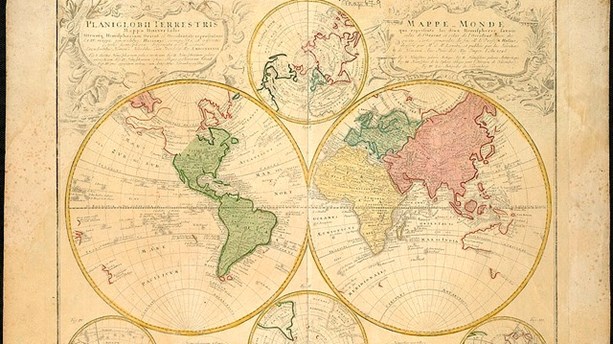
Mappa Mundi

mappemundi

The key question is not what a given sentence means but what it does, especially how it does whatever it does…to know is by definition to say that something is something else and be believed when one says it – Gunnar Olsson, Abysmal

Whatever we might say, we see in all that we say. – Sophocles

Only apparently is it a ‘presentation.’ – Martin Heidegger

It follows that in the world of humans any mark is better than no mark, for without categorization there is nothing at all, not even nothing at all. – Olsson, Abysmal

How small life is here / and how big nothingness.  – Robert Walser, Oppressive Light

Alias Thinks Back…On…

“To bring a work to ‘a conclusion,’ as Picasso said, is like putting an end to a bull – to kill it.”

-Francois Jullien-

diaries

from the diaries…

Woke this morning with a particular feeling.  I’ve never been one to believe people could name their emotions or feelings.  The best we can say are parts.

Words like a parts catalog: indicating pieces and components, but never the working, not the operative whole.  Machines are full of mystery.  What’s hidden.

They say you cannot know.  As you age.  Cannot know if it’s the end, exactly.  Perhaps they’re right – I’ve surely been surprised in middle age, believing everything was lost, doomed, downhill and erosive, some slow and steady depleting – and then WOW!  Who could have known or imagined!  This luck, this place, this woman or experience!  Perhaps.  Perhaps.  But maybe we do.  Maybe we really know, once twilight settles.  I’ve never trusted “them” – the “experts,” the “scholars” and “scientists,” “politicians” or “leaders” or “doctors,” the “speakers for” and “authorities”…i.e. privileged observers (an illusion or delusion or both – no one ever gets to be ‘outside’ existence, any more than any other).

What with Laramie gone, and a birthday round the corner, and language just a parts catalog – my experience.

I woke with a particular feeling.  That things were near their ends.  That I am nearing ends.  Work, love, breathing, will.  That the stories I’m involved with are dwindling in pages, thin and wearing out.  These ‘particular feelings,’ “somehow we just know,” kinds of things: lay down, close your eyes, cross your hands over your chest and hope things are in order.  Or not.  Depends on inclination and values, I suppose.  What one cares about, or for.  Perhaps.  “They” say you cannot know.

I’ve been surprised.  Even wildly.  Much I’ve never been able to believe and yet it seems: my children – engendered by me and of such promise; this beautiful woman that loves me; that I’m still alive.  One never knows (is what they say).  So who knows what?  And how do “they” know that?

I think I do, what with Laramie gone, and my faulty parts catalog, and this particular way that I feel.  I’ve worked too long and too much.  Tried too failingly.  Never quite trusted or believed.  Never found my worth.  Maybe now I know.  Maybe now I’m certain of something.

The end is coming – for me – always concerned and consternated by beginnings – how to start, where to set out – and now, here (nowhere) the path, it dwindles away.  What have I done?  What did I mean to?  What did I wish?  Why didn’t I?

I wanted to write a scholarly work about something that truly obsessed me.  Something I’d spent my life searching.  Something that likely doesn’t even exist, but no matter – because Scrabble, because poems, because science.  Unscramble (by scrambling) the letters – you’ll see: it can almost be said, almost anything – existent or not – almost.  Parts constructing strange wholes and plugged in, eventual malfunctions, repairs – and yet “no matter, try again, fail again, fail better” (Sam Beckett – I’ve read and I’ve taught far too long).

And one solid work of fiction and some poems.  That’s all.  That’s what I wanted to do.

So I studied, and traveled and loved.  Raised children, made music, pushed learning and literature publicly, worked and worked, and drank and drank.  Took in stragglers and strays, made it work where I could, doubted and doubted, desired.  Everything but what I wanted – that’s how you perpetuate desire.

I woke today with a particular feeling, though “they” say you cannot know.  Cannot know for certain, that things are yet to surprise you, yet to get better.  I will not argue.  Perhaps.  But what with Laramie gone, and all that’s undone, maybe I know, maybe we do.  Maybe we’re aware when our endings are coming.  Who could know?  Who could tell us?

My ends are coming.

I can’t go on.

I’ll go on.

(still more from Beckett)

Related: Alias Harlequin

Report: Beginning from the Endless End: A Community of Thinking: The Experience of the European Graduate School

Apply Now: Begin your MA/PhD this Summer 2016 in Saas-Fee, Switzerland

Report: Beginning from the Endless End: A Community of Thinking: The Experience of the European Graduate School

“the center of thought is that which does not let itself be thought”

– Maurice Blanchot

Perhaps a community. 

A community “risking a fragile resilience” (Philip Beesley).

“Distinguishing the indistinguishable.”  “Compatible Incompatibilities.”  “The Origin is Empty.”  “The path to truth is truth itself.”  “More than 1, less than 2.”  We are always with without. 

I feel rich, calm, a sense of belonging.  And loss.  In my second year of a PhD program at the European Graduate School, nestled far and away in the Swiss Alps, in the canton of Saas-Fee.  It is June, it is chilly, high, quiet, separate.  Far from the searing plains of Kansas.  Far from my employment, my partner, my children.  Far from domestic duties and sustaining (endless) chores.  Removed, set apart, drawn up to the mountains, the rivers, the snow.  Another language, an other culture, a situation of difference.

Mladen Dolar, following many great others, tells us we must “slow our temporality.”  That we can “only do philosophy if we pretend to have all the time in the world.”  How could this be done within the everyday?

It feels monastic almost.  30-40 humans from all over the world gathered to hear, speak, inquire and reflect.  Many silences.  All impassioned by the above – the difficult work, accidental work, error-filled work of “distinguishing the indistinguishable” finding “compatible incompatibilities,” facing the “empty origins,” and setting onto the path that has no end, in the risk of a “bad infinity” – of selecting or creating or imagining impossible tasks and eternally postponing them, finding no conclusions, resolutions, foundations – everything put into question, everything problematized, intervened – “the truth is mediation, a passage.”  The happening, the process, of thinking.  So we believe.  And so we gather.  With eminent leaders, guides, mentors (for example, this session: Slavoj Zizek, Helene Cixous, Philip Beesley, Christopher Fynsk, Mladen Dolar, Jean-Luc Nancy, Keller Easterling, Chris Kraus, Alenka Zupancic, Benjamin Bratton, Werner Hamacher, Anne Carson…and more…).  We hear from them, we question, we think with them, think FOR other thought drawn toward us (Hegel, Aristotle, Plato, Heidegger, Foucault, Lacan, Freud, Deleuze, Blanchot, Spinoza, Holderlin, Goya, Beckett, and on…).  What lives, what continues in our seemingly endless end.  What might in-form and unsettle us, what might disturb and enliven us, how we might change-in-relation, again and again and again…

To “take all the time in the world” for 30 days.  To read closely.  To be overwhelmed.  To exhaust.  To end again and again, to fail in hopes to fail better.  To “start in a bad way, in order to arrive in the good.”  The process and problems.  Our “selves” in becoming, the one and the two and the many – always with lack.  Negativity, absence.  “Nothing is identical to itself.”  The “greatest order and disorder exist as one.”  “Constancy is slipperiness and change.”  How do we dwell there and evince.  How do we act to find out?  There is always the other, another, a lack that we seek.  That is nothing, just lack.  Drives and desires and neuroses.  The community of thinkers.

Some of us question “what is wrong with us?”  Why a surplus enjoyment of troubling existence?  Why identities founded on nothing?  “Philosophy always arrives too late” (Hegel).  We can only begin at the ends.  Against nothing.  Yet toward.  And it is here I feel valued.  Here recognized.  Here is a home.  I belong.  In a timelessness of knowing in time.  An everywhere of nobodies anywhere.  Senses replete with mountains and rain.  Clear air and short breaths.  An absence of tasks.  Singular tasks.  Monumental tasks (for me).  That need all of the time in the world.  Are all of the time of the “world”.  Senseless letters.  Turbulent being.  In media res – in the middle of things – when outside already inside, inside where something’s always left out.

My collegiate journals from decades ago are riddled in their margins with: “to be the writer of loss,” “to be the philosopher of grey,” “to compose absence.”  A longing for empty origins since thinking began.  Repetition.

I walk for the body to process.  I dream of sharp thorns in my feet, of lost items, of absence and language and two shades of grey.  Rain comes through the clouds in the fog.  “The end is in the beginning, and yet you go on,” “My mistakes are my life,” – Samuel Beckett.  And so, and yet, I go on.  Intensively, demandingly, having “nothing to write, having no means to write it, and being forced by an extreme necessity to keep writing.” – Maurice Blanchot.

I miss those I hold nearest.  And I love them – how indecipherable the term – further description annuls it.  To say the unsaid or unsayable.  I am confused and elated.  Inspired and exhausted.  Drawn forward through despair.  And I love this experiencing.  It belongs.

“If nothing were substituted for everything, it would still be too much and too little.”
― Maurice BlanchotThe Writing of the Disaster


On Being Other

On Being Other

(after Heidegger, on Holderlin)


Broken off from origin: gods, family, homeland.

Early switched direction – turning back, against, since.

No belonging.  No church, no community of mortals.

Reliant on the peaks and the abyssal.

No lasting love, but efforts toward convention –

when giving up –

even offspring, domesticity,

varietous employment,

almost friends.

No lasting commerce, always in-between,

feeling resistance and restraint,

constraints of discipline and need,

of longings, love, and lust.

Searching Other

fueled by others – across the times –

creators of the peaks and their abysses.

Oscillation.

Not yet rational, it commences –

undone in the unknowing, uncertain constant flow

generates turbulence toward an opening

or a gap, some kind of fold –

“run up hard against the unsayable.”

the closing line is a quotation from Heidegger’s

lectures on Holderlin’s poems “Germania” & “The Rhine”

Impossible objects – Possible beginnings

Question-Mark-HD-Wallpaper15

“We enter into thought, and especially our own, only by questioning”

-Maurice Blanchot-

This then, an impossible object with possible beginnings.  What says, what writes, what IS – all filled up with what is NOT.

Capture, mediation, confluence.  The impossible attempts, the radical effort: I attempt to SAY, to INSCRIBE, that which is incapable of being said, inscribed, touched or revealed: experience, THIS-NOW-HERE, YouMe.

This is what, then, I will create / not-be-able-to-create.

click here for more…