The Absence of Center

“poetic language directs us not towards what gathers together but rather towards what disperses, not towards what connects but rather towards what disjoins, not towards work but rather towards the absence of work […], so that the central point towards which we seem to be pulled as we write is nothing but the absence of center, the lack of origin…”

-Francoise Collin on Blanchot

maurice-blanchot-4

Click to access Peter%20Pal%20Perbart.pdf

Click to access Peter%20Pal%20Perbart.pdf

Click to access Peter%20Pal%20Perbart.pdf

Click to access Peter%20Pal%20Perbart.pdf

Meaning

From an email conversation I am involved in regarding human relation to technology…seemed to expose a who-I-am via what-I-concern-myself-with moment in my life worth sharing… and would love any/all comments, ideas, perspectives, regarding:

“I like that inference of thought…influence of larger and smaller systems interacting in our particular (as Lemke refers to them – “focal levels”) living.  I think from Heidegger onward that attention to the reciprocal or interactive influence of what we devise/make and who we are and what makes us continuously reshaping/constructing/constituting us IS a fundamental challenge/question Humanity is within.  This is why I am drawn to technesis as a human activity.  There is no difference from developing domiciles and agriculture, accounting and writing, language and representation in its holistic alteration of the species as there is with what we are within with the devotion to the “digital” – an oddly ubiquitous remediation of experienced matter-ridden-media into this ONE SORT OF ORGANIZATION/CODING.  A strange phenomena.  I think the nearest relative is “writing” and this is where Hansen (“Embodying Technesis”) and Hayles (“How We Think”) as well as Hodder & Ingold’s anthropological works help elicit perspective (& Kittler) on how ALL technological development (craft, architecture, invention, production) so foundationally EDIT us as a species… akin to geophysical change for all forms of biological life.  I suppose what I hope for is some small increase in awareness &/or experiment of capability for Human-kind to discern what amount of agency we may (or may not) have in relation to what we evolve and construct.  Is the system too vast – the biological motive too strong – to continue exploitation and networking (also increasingly representative of our fundamental relationality) – or are we a kind of thing that can affect larger systems in such a way that is transformative?  How small of a part are we, what are our limits of capability, do we have ANY genuine (actual) capacity to discern telos of larger systems… or not (trickles all the way down to personal behavior and ‘psychology’) – can we ever determine our AGENCY (collectively / personally / speci-ally)?  Or is it airy imagination and the activity of abstraction?

Sigh.  This is where I’m at…”

Something Becoming…Shaking a rattle

SHAKING THE RATTLE

“our fear: this is what we are made of: our weakness”

– Helene Cixous

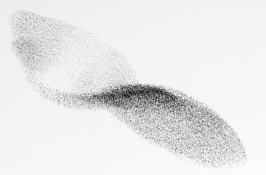
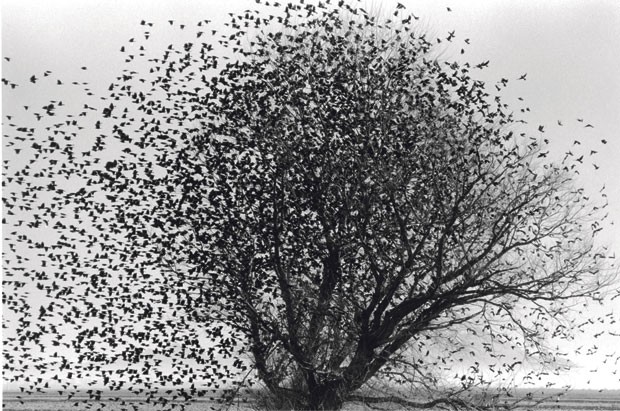
“A flock of birds turning in the sky is doing something that people don’t know how to do: moving together, beautifully, without a leader or choreographer…I study ant colonies, and how they get things done without any central control.”

– Deborah M. Gordon in Lukas Felzmann’s Swarm

lead_manuel-prestl-der-vogelschwarm

“Let us agree to apply the word ‘talk’ to all ways of experiencing sensations, actions, and ideas in signs of any kinds, and also to all ways of interpreting signs, and [let us] apply this word ‘sign’ to everything recognizable whether to our outward senses or to our inward feeling or imagination, provided only it calls up some feeling, effort, or thought…Nothing does speak for itself, strictly nothing, speaking strictly.  One cannot bid his neighbor good morning, really, effectually, unless that neighbor supplies the needed commentary on the syntax.  If he does not, I might as well shake a rattle.”

– Charles S. Peirce

(click anywhere to enter)

Borrowing: James

Felzmann - Swarm

“In the pulse of inner life immediately present now in each of us is a little past, a little future, a little awareness of our own body, of each other’s persons, of these sublimities we are trying to talk about, of the earth’s geography and the direction of history, of truth and error, of good and bad, and of who knows how much more?”

-William James-

Temporality: or, “in your absence I dwindle, I diminish…’I’ disappears”

for Hallie

(please read in pace with tune below)

absence

I.

Feel.

Profoundly.

Meaning

(less).

from the Ruled Writing Tablet

ruled writing tablet

Interstice

I told her that I would have told her, had I known.

-“Known what, exactly?” she said, “Really!?” she said.

Yes, I said, yes, I would have explained what I felt I understood – about the “interstice” – what I felt I understood, I would have said.

As usual, the sighs, the diverted glances, the “I-don’t-knows.”

It’s alright.  I’m pretty used to it, not that it no longer hurts, or squashes some part of me, but familiarity breeds…and it’s not contempt, at least for me.  More like resolve, or, well, I don’t know.

Still I would have conversed about the “interstice.”  Or its plural.  No one can know what we’re talking about (in my opinion) – that’s why we talk (in my opinion).  But I do like to look at her.  And sometimes keep talking so that I can look at her longer.

Thus I would have explained – or attempted to – about the “interstice”… had I known, I tell her.

– “Known what, exactly?” she asked, “Really!?”

It’s ok.  I’m pretty used to it – exasperation.  It’s a sort of fatigue that settles on my interlocutors – my family, my friends, my lovers, my children – as I triple/quadruple/undendingly (exponentially?) second (meaningless term in this context) guess whatever it is (emotion, idea, memory, event) I attempt to convey.

I find I do not trust a thing as long as it might be questioned, and I have yet to discover something unquestionable.  I like inventing titles though.

She’s looking at me – softly, sadly, gently.  Sometimes she strokes my hair and lets me rest my head (the physical part).  It helps.  But the rest doesn’t rest.

Fair enough, for the most part, I’m used to it.  It’s “me” (as we are wont to say) – what I’m accustomed to.  It doesn’t matter, or does in unquantifiable ways, but I keep at it.  Anyway.  I can’t help it.  Well, some things do – vodka, sex, sleep – but only temporarily.

Things are only temporary.

That’s the sort of idea that keeps me alive.  Temporarily.  And second-(exponentially)-guessing.

Interstices1

She’s still there, here, though.  Hence the interstice.  I try to explain.

*

As if “interstice” possessed a meaning, a definition, beyond the moment I activated or utilized it.  As if it indicated.  Meant – convergence-point (limitless above and below and around) of time and space conventions in a realm that felt (seemed) shared.  Held in common.  Nothing is “held,” or only temporarily.  Changed with its containment.  It seems.  I don’t know.  It’s certainly questionable – is it, ‘certainly’?

I don’t know.  Which I thought, or think, is the entry to wisdom, but even that – I don’t know.

She’s still here.  And I question – Who is it?  Who is still here?  And what for?  How? Why?

And where is the vibrating “here”?  And what for, how &/or why?  I can wonder.

– “Wonder what, exactly?” she inquires.

I don’t know.  I’m a human.  An odd conundrum of pieces and parts that correspond or reciprocate in hold-together activities for a while…call it “organism,” there’s that, it would seem, but seem only, digging in it is hard to convince or confirm – a location, identity, consistency, avocation or being.  It’s just so – apparently – temporarily.

Exasperation.  You see?  You dig?  What I mean!?  That’s what we’re after (together, I think) what it means.  But what that means is uncertain, I think or surmise.  We don’t know, it would seem, we’re uncertain.

We ask.

The ’45: Considering Complexities – On Plasticity of Identity

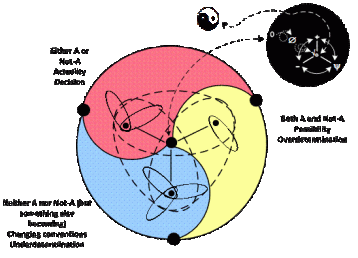
floyd merrell diagram

On Plasticity: Being Ourselves, Able to be Ourselves


My birthday recurred.  Post-40 in a thriving family of 6, there are not many days deemed “special” that end up being about oneself as the father, caretaker, partner, provider, no matter how small the scope of the surround.  Soccer games and music lessons; feeding times and laundering; all keep going on – birthday or no.  The exhaustion continuous activity and felt responsibility breeds seems to increase in proportion to the numbers signifying one’s years upon earth.

But there are flourishes and touchings – like small miracles – proffered patience, generosity and deference gifted one’s way as the children mature.  I received momentously considered and thoughtfully creative presents and offerings from my brood, including the effort of travel (a 5-hour drive for a 3-hour meal), some self-deferrals of wants and demands for a day, shared and repurposed objects and much love and affection.

In the midst of which my brother-in-law texted: “And what have YOU done for YOU today?”

***********************************************************************

Isn’t nearly everything we do for ourselves in some way? I thought.  Caring for those we love, providing for their needs and responding to their living feeds our hope that we might be valuable partners and parents.  Enabling others’ satisfactions or play, achievements or events provides a goodness and gladness to our sense of identity.  WHAT DO I (or would I) WANT?  [If things revolved around ME? – What would I select for MYSELF, my TIME, my ACTIVITIES, were my surround and environment conducive, supportive, adaptive and compliant – attuned to MY wishes and feelings, desires and preferences – as its Center and Hub?]

This engendered heavy pause.  Followed by weeping.  Since my youth I’ve pleased people.  Especially those I crave being pleasing to.  Ever considering: if I find them, serve them, fuel them, tend to their whims and their moods and their wants and don’t fail them – they’ll have NO REASON not to accept and acknowledge me, enjoy and delight in me…perhaps even come to NEED and to LOVE me!

Still most of these persons have come and then gone – not needing an enthusiastic audience-of-me, my support systems or enthralled amour, cooking skills, cab driving, housekeeping, therapeutic attunement, nursing or cock…so much as an “Other,” I suppose.  An other alike with mixed needs, wants and cares, fears, doubts and preferences…uncertainties.

WHAT WOULD I WANT?

Being malleable, self-deprecating, at-your-service and adaptive in order to eventuate my longed-for (but not fully realized) purposes of belonging, chosenness, appreciation, acceptance and love, predisposed me to the Phenomena of Plasticity.

That organisms jostle and interact, adjust, emerge, revise and alter in accord with their environments and one another toward an imagined maximum survivability came as no surprise to me.

That my brain and body bend and twist, reconfigure and rework themselves toward perceived pleasures, building likewise to avoid potentially death-dealing pains, forms an accurate metaphor of my experience.

Do this, try to be that, retrain the brain, assimilate languages, nuances, behaviors and tastes, become parent and scholar, musician and lover, friend and coworker to an enormous variety of persons, places, and things (or situations).

Sounds desirable!  After all, we’re fascinated and entangled in networks and viruses, Renaissance-personages and extensive applications and sites – world seems participatory, fluid, collaborative and self-responsive – play-doh, silly putty, plastics, rubber and earth.  Water, air, flesh and fire.  Living would seem to be a plastic rather than static affair – examine a corpse! (and observed long enough, even then we’re not done and prove pliable and transforming).

************************************************************

Yet for me came a hitch as I pondered all this.  A lifetime spent adapting, responding and recursiving change for results that never quite arrive in a reality where even those chances will cease…

WHAT DO YOU WANT FOR YOURSELF?

When the question is put to me:  “What is it, right now, you prefer?” it turns out, among many acknowledgedly diverse and contradictorily complex cognitive-affective responses – I USUALLY KNOW WHAT I’D PREFER.  Very few options taste best to me in any given moment, and their range and scope are slim!

And then there’s the fact that I feel great admiration towards those who speak their mind and express their desires in a direct manner!  They still may compromise and adapt, but both adults and children who proclaim what they feel and want, prefer or need, ever impress me.  I (on the other hand) tend to try constantly to guess and anticipate what those around me prefer or desire before asking into my own – as if to say – if there’s room or time after all of you…I’d sure like to…but by then I’m too tired.

***********************************************************

So how plastic are we?  How multiple, really?  Since age 7 or 8, 12 or 15, my core desires have been pretty consistent:  Read.  Write.  Love.  Sex.  Explore.  Make.  At any given moment, regardless of conditions or surround, regardless of the options even, my litany of WHAT I WOULD DO FOR MYSELF usually boils down to this brief list.  In addition to which, I usually have a good idea of who, where, what, when, and sometimes how I’d go about each of the same – if conditions, environment and possibilities were dependent on ME.

I’ve definite tastes and predilections, ways I like to feel in what venues, activity-biases and condition proclivities (even though those nearest me often say they’d never know it by my choices).

Maybe the Phenomenon of Plasticity hypothesis runneling its now-scientific way through the cosmos and further than cells is a living CAPACITY but not necessarily a QUALITY?  Accident not essence?  Perhaps plasticity suits the powers-that-be, our politico-socio-cultural nowthen (STEM disciplines, Markets, Politics & Capital, Networks & Technologies) that would love for us adapt and adjust, go-along and “flow” as if its “natural,” “observable” and “scientific fact”?  (At the moment).

I’m not disputing it’s COOL – our abilities to change and flex, evolve and habituate, refashion and conform – and indeed it’s often necessary for our survival – but there’s a gap, hesitation, incompleteness to the story.  It doesn’t “FIT” to experience, or only partially so.  Something’s being assumed underneath.

And what is that?  Why have I preferred preferring others to my own, yet not ceased having my own all these years?

How would I be if I believed ALL were equally plastic?  That it wasn’t my job to adjust to everyone, remake to everything around me, instead insisting upon their/its relative capacity to reshape and orient to me as well?

WHAT WOULD I WANT if I could “be myself” (express my consistent biases and longings, behaviors and thought-trajectories, mood-palette and drives) in environments in which I was enabled/able to be/do so?  A surround that exercised the capacity of plasticity in relation to ME?

NOT EITHER/OR

Granted, some do, (those that stick around or don’t realize a choice) and in varying degrees, but I seldomly bank on that and announce or convey myself…usually I hedge against abandonment or rejection – fear of pains winning out over hopes of pleasure.

That’s “natural” too, the disciplines say – but there are so many counter-examples: ones who openly state their “I would prefer not tos” or “I would prefers…”  What have they got on me in this plasticized universe?

**************************************************************

There’s expression:  I prefer finding questions.  Ferreting unknowns.

FOR myself – there, I’ve done it.  At least once today.

09.22.2015

The Living Dead: a Reflection

“Dad, are you living or dead..ing?” son asks at dinner (aged 9).

Characteristic pause…”Well, both,” I reply.

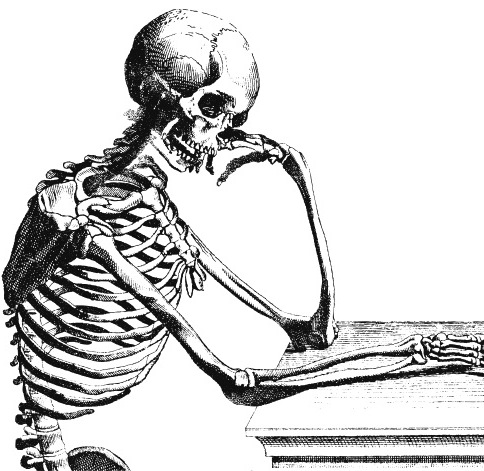
sad skeleton

How could it be otherwise?  I’ve stayed the course, exercised my body, prepared a meal, feeling fine, alone, aware…and comes the call:  “Living or dead..ing?”  Parental response – stop.  [Why is he asking?  What is he thinking?  How is he feeling?  Bodily signs?   Follow the language – “living or dead…dead..ing…dying.”  What is called for here?]  He thinks the living dead a lot,  so I respond directly:  “Well, both, and how could it be otherwise?  I couldn’t very well be dying if I wasn’t alive, no?  And the process of dying is constructed of living, yes?  So it’s all in one moment I s’pose.”

We move on.

But I don’t.  Not so much.  It’s a good question.

It reminds me why I’m a philosopher, a poet.  Why we tend toward the same, differently.  We watch for the shared, the communal in our experience, anywhere.  We work the same queries.  In a living ruled by science, by probabilities and hypothetical cause, by vague notions of what-might-happen-next given conditions and dynamically complex systems…philosophers, poets and artists tend to seek out what’s certain – what is nevertheless the case: we feel, we think, we live, we die, a world is there – the details change with the order of the day.  Or night.  The language or discipline.  The methods or culture, practice or beliefs.  Depending on the questions.  Who’s asking and how.

We happen – become – and unhappen.

Because my dad, almost 80, evinces this.  Because I’ll be half-90 in 48 hours.  What I asked for is called Cosmic Pessimism, which says something.  I happen…vary…and stop happening that way.  How that occurs, what and who and when and why change nearly as quickly as we do.  Should I say, what we think or believe occurs?  Rationalization of experience.

Reminds me of this, of the action of writing.

I still can’t do it “live.”  Can’t inscribe it as a “post” or a “tweet” or a “message.”  I’ve got to get some static.  IN-scribe is a physical act of scratching, digging, carving in clay.  ON-scribing is more what we do – laying down ink, pounding down letters, playing with light.  Writing with materials like paper and ink relatively makes something stay put for awhile.  So we can revise.  Perhaps that’s all Rilke meant – give yourself the opportunity to edit, erase, respond to your action before you present it.  Is revision revivification?  Stay something, pause.  Apply yourself to your living and choose an occurrence.  Does this wrinkle the union of living and dying?

At work I’m struggling with teaching the methods of multi-disciplinary research.  How to template a strategy of awareness to potentially everything?  We’re living and dying and attempting to know, understand, RATIONALIZE something about that.  Literally ANYthing applies, or may nourish, correct, influence or direct that essential inquiry (and DOES!).  How does one know where to look?  How does one know how to live it?  How does one know what one needs?  To synthesize rationalizations from multiple fields and methods and practices.  To compare all the answers or theories or thoughts?  To differentiate results and observations coming from various humans and schools and materials and tools and contexts and set-ups and the myriad messiness of living/dying organisms in relations beyond our control?

“You must revise your life” (Rainer Maria Rilke).

Revising your dying.  Is it possible to live moments in such a way that they outstrip the correlative dying?  To live more than die?  Once in awhile?  I think we have experiences, moments, in which we feel more alive than in others.  “Are you living or dead…ing” he asks.  Well, waking into a maze to traverse every day – cleaning and feeding and playing the roles (father, lover, employee, friend, son, writer, scholar, blogger, house-owner, house-keeper, cook, playmate, librarian, instructor, male, man, person, reader, and so on), shopping and feeding and listening and nourishing and working and running to tire – feels a bit more like “dead…ing.”  But there are moments!  Times.  “Events,” we call them (I guess).  Twistings and turnings and something like gathered occurrences, Being + Well-Being, Whitehead might say.  A more spectacular death I suppose.  Perhaps elevated experiences of living just heighten the jouissance of death?

I don’t know.

We happen – become/unbecome – and unhappen.

The marks left from that – our inscriptions, palimpsests and paths.  Veined.  Seared-in.  Scored.  In some cases, welded – some cases cancelled, erased, blotted out.  Living-dead…ing.  Vice versa?

To edit, revise, pause – is it possible?  What did he mean?  What might it mean?    Curving back doesn’t alter the time.  Going over is still going forth.  We wend and wind and whirl and reveal we are living and dying.

Short essay on Venice Biennale experience – Summer 2015

Glimpse of Lightness : Venice Biennale 2015
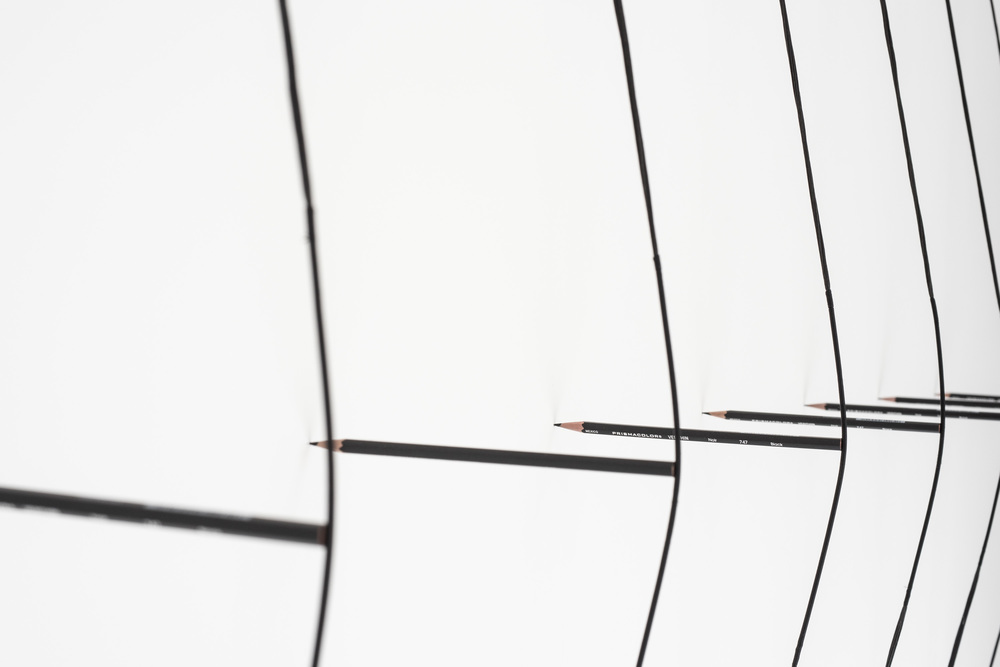
Maggi - Drawing Machine

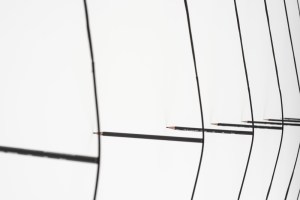
Marco Maggi – “Drawing Machine” – Uruguay Pavilion, Venice 2015

            How does art “happen”?  What is a work of art in an age of reproduction?  Who, where, what, and how are we in relation to composition, construction, collage, creation, craft… encountering “art” as a strange “zone of indistinction”, an “undecidable”[1], perhaps an interference, or intervention – at the renowned Venice Biennale 2015?  What lightness might we glimpse in such immersion, inundation, veritable floundering and bewilderment among “works of art” – the touted greats within the most prestigious cultural institution in the world.[2]

In a deep cleft of Agamben and Heidegger, physical and mental exhaustion, a set of European Graduate School students (which gratefully included myself) set out to engage “art” in the context of the famed Venice Biennale Exposition, assigned to look for “glimpses of lightness” – something “having little weight…alleviating…demonstrating ease or agility…mirth, levity…and a graceful slenderness”[3] OR – “lit brightly, illuminated, illuminating”.[4]  The day began hefty and hot with prospects of 89 national participations, 44 collateral events in the Giardina della Biennale plus an additional “more than 136 artists from 53 countries” at the Arsenale.[5]  We set out.

The 2015 Biennale was filled with many ambiguous / ambivalent / open works that, depending on the perspective of the observer, might be engaged with levity, mirth and playfulness or burdened by art-extraneous political, moral and conceptual communiqués and paraphernalia.  I found myself wondering if art was happening in such a context – a deluge and glut of politics, morality and economy.  I began looking at things curious if messages could be untangled, read past and through, passed by: emotional, commercial, personal, national, site-specific – querying – “what here is ‘being raised, set forth, set up’? (Heidegger).  ARTing: can we come to art through artists and artworks and exhibitions?[6]

Considering art as Riss – rift – an outline, sketch, drawing and marking setting into relief a “moment” or “space,” a new relation hard to distinguish, perhaps undecidable, opportunities of encounter with encountering-itself, being – itself – being, in relation to.  A passage.  Something beyond good and evil (ethics); beyond division, calculation and measure of perception (subject/object, this/that, here/there) (ontology); beyond narcissism (me/you, us/them, him/her) (epistemology); beyond laws and institutions and individuality (ours/theirs, who/what, when/where) and so on… Toward activation – activity + occurrence, an awareness, a-tension at/of/with/in NOW? [ultimate zone of indistinction and undecidability].  Play?  Lightness?  Resisting the urge to pronounce, proclaim, propose; swerving past strife, through strife – holding open? – Art…as Being…an open question?  Some undoing in its doing, some common toggling call to a present, re-present, encounter?  Are we able to tear up a world in an activity of mending, assembling and combining it (rift)?  To set up a world in an activity of revealing (veiling/unveiling) as a poet might do (oscillating signs) with a semiotic semantic, ex-hibit-ing, exposing, en-light-ening – making lines instead of following them, opening spaces rather than closing, becoming in difference to became?  I wondered what might result if we scrambled the sites/sights on some randomizing algorithm of names/nations/pavilions or scrambled the labels and ‘statements’ according to same.  To undo in order to Art.

So what rends?  What can tear through the amalgams and overlays we bring to each encounter with one another, with the world?  What might cause a rift to occur in my own perceptions, predispositions, cares, concerns, propensities?  Where do the potentialities lie?  What will bring me to the open?  Below are a few works I encountered in the heat and dust and exhaustion of 2015’s 56th La Biennale di Venezia that re-oriented me, turned me into at least two sides of a chasm, illuminated a seeing-space, a being-space for me – provided me with glimpses of lightness.

Blind Spot.”[7] The first work that woke me, intervened, destabilized and shifted my course was Blind Spot by Mykola Ridnyi (Ukraine) located in the Arsenale.  Working from the ophthalmologic  analysis of scotomas – areas of partial alterations or degenerated acuity in our normal fields of vision that are surrounded by normative and well-preserved views.  We all have them, aspects we never see clearly – biologically, culturally, psychologically and personally.  Scotoma is not a condition to be overcome, but to be aware of.  As I engaged the Biennale, I recognized that artists, nations, participants and audiences all live their existences with “Blind Spots.”  The effortful work to account for them only serves to expose further areas where “things disappear on us.”[8]  Accompanied by C-prints painted with various exemplars of scotomic affect, Ridnyi’s installation ripped an awareness into me that opened my emotional reactivity to nation-state pavilions and exhibits, artists compromises to culture and fame, my own dear lack of self-critique and clear-sightedness, and the ever open question of how and what we engage in our being-alive, relating, and “reading”/”seeing” the world.

Not far beyond “Blind Spot” resided Ricardo Brey’s “Every life is a fire (2009-ongoing,.”[9] intricate, redolent boxes opening out in glass cases – the layers, complex details and labyrinthine qualities of our coagulating, webbing construction of idiosyncratic interpretations of the world.  “The box is our head,” he notes, “the box is the cave… is the attic… is the memory and the world.” The boxes are an attempt to represent the intensifications of internal modes and their relationships in spatial terms; and what results is a “hermeneutics of the soul” that creates “a topography of the mind.” Articulated like a labyrinth or mandala, Brey considers the box-mind compound the “most metaphysical project” he has attempted, nothing less than “a workshop to produce the invisible” or “the countless” that is also “the way out and the jail.”[10]  The attempt to articulate the inarticulable, visualize the unseen, expose blind spots through elaborate archiving and representation and obsessive care and attention also ripped into my own desperate strivings for self-awareness, knowledge and authenticity.

And finally, yet in retrospect to my Biennale’d day, an early return…Marco Maggi’s Global Myopia (Pencil + Paper) (Uruguay Pavilion) and, particularly, his piece at the entrance to the show: “Drawing Machine (nine possible starting points)” (image above).  Options.  Beginnings.  Openings.  In what direction will the “drawing” move?  From what emphases and characteristics?  What intricacies of our histories and culture, memories and desires, experiences and imaginations will direct the ensuing mark of us in relation to our world, ourselves, our perception, one another?  Maggi reports, powerfully, that “ the only subject of Global Myopia is drawing.”[11]  Lines begun – a movement, a glance, a word, a new distinction.  Rifts and rendings, gaps and site-specificities, we inscribe – blindly, collectively, collaboratively, actively and in elaborate idiosyncratic ways both laden and illuminating – glimpses of lightness outlining our crossings, traversals and conduct through All the World’s Futures.[12]

References

Agamben, G. (1993). The coming community. Minneapolis : Minneapolis :

Agamben, G. (1998). Homo sacer. Sovereign power and bare life. Stanford, Calif. : Stanford, Calif. :

Agamben, G. (1999a). Potentialities : collected essays in philosophy. Stanford, Calif. : Stanford, Calif. :

Agamben, G. (1999b). The man without content. Stanford, Calif. : Stanford University Press, 1999.

Agamben, G. (2004). The open man and animal. Stanford, Calif. : Stanford, Calif. :

Blind spot – Mykola Ridnyi. (2015). Retrieved August 30, 2015, from http://www.mykolaridnyi.com/works/blind-spot

Every life is a fire. (2015). Retrieved August 30, 2015, from http://www.ricardobrey.com/every-life-is-a-fire.html

Every life is a fire. (n.d.). Retrieved August 30, 2015, from http://www.ricardobrey.com/every-life-is-a-fire.html

Heidegger, M., & Heidegger, M. (1977). Basic writings from Being and time (1927) to The task of thinking (1964) (1st ed). New York: Harper & Row.

Heimo Zobernig at the Austrian Pavilion, Venice Biennale / MOUSSE CONTEMPORARY ART MAGAZINE. (2015, May 13). Retrieved August 30, 2015, from http://moussemagazine.it/zobernig-austrian-venice-2015/

La Biennale di Venezia – Biennale Arte 2015: All The World’s Futures. (2015). Retrieved August 30, 2015, from http://www.labiennale.org/en/art/news/05-03.html

La Biennale di Venezia – History of the Venice Biennale. (2015). Retrieved August 30, 2015, from http://www.labiennale.org/en/biennale/history/

La Biennale di Venezia – Home. (2015). Retrieved August 30, 2015, from http://www.labiennale.org/en/Home.html

lightness, n.1. (2015). OED Online. Oxford University Press. Retrieved from http://www.oed.com.proxy.wichita.edu/view/Entry/108230

lightness, n.2. (2015). OED Online. Oxford University Press. Retrieved from http://www.oed.com.proxy.wichita.edu/view/Entry/108231

Welcome. (2015). Retrieved August 30, 2015, from http://www.marcomaggi.org/welcome/


[1] (Agamben, 1993, 1999a, 1999b)

[2] (“La Biennale di Venezia – History of the Venice Biennale,” 2015)

[3] (“lightness, n.1,” 2015)

[4] (“lightness, n.2,” 2015)

[5] (“La Biennale di Venezia – Biennale Arte 2015: All The World’s Futures,” 2015)

[6] (Heidegger & Heidegger, 1977)

[7] (“Blind spot – Mykola Ridnyi,” 2015)

[8] (“Blind spot – Mykola Ridnyi,” 2015)

[9] (“Welcome,” 2015)

[10] (“Every life is a fire,” 2015)

[11] (“Welcome,” 2015)

[12] (“La Biennale di Venezia – Biennale Arte 2015: All The World’s Futures,” 2015)
Librarian & Litterateur…

Makeover Day

I am not a scholar.  I know that now.

I am middle-aged.

I have pursued no discipline, field, or “area of knowledge” to its limits.

“Core literature.”

Librarian.  “Litterateur” (awful sound).  These.

Exploring fields: science, literature, philosophy, history, critical thought – through the “core literature” – the Canons of the Field.

Only so far.

Not to the ends.

What a novelist needs.  Knowledge a little beyond average, a little obsessive, a little “never satisfied.”

A librarian: able to discourse with “Scholars” in any field – enough terminology, vocabulary, “core knowledge.”

“Jack of all trades, king of none.”

Yes, that.

Librarian.  Litterateur.  (I don’t know what else to call it).

Me.

Degrees in Classical Music, Theology, Philosophy, Information Science, Art & Critical Thought.

It’s something.

But not “scholarship”.

Core Knowledge.

Trying to be human.

Trying to know what I need to know to be that.

Trying to be.